


Getting the PU foam mix wrong can ruin your product batch. This wastes expensive materials, costs you money, and causes production delays. Understanding the typical mixing ratio is the first step to avoiding this.
A typical mixing ratio of Polyol (Part A) to Isocyanate (Part B) is 100:(30-150) by weight. This ratio is critical and depends on your specific foam formulation. It ensures final product properties like density, hardness, and resilience are met. We adjust our machines for each client’s unique needs.
That ratio range seems wide, and it is. The number you see on a technical data sheet isn’t just a suggestion; it’s the core of your entire production process. But getting that number from the paper into a perfectly formed foam product involves more than just setting a dial. It’s about precision, control, and understanding the factors that can change the outcome. Let’s explore what that really means for your factory floor.
What is the standard mixing ratio for polyurethane in high-pressure foaming machines?
You see different ratios online and feel confused. Using the wrong “standard” ratio for your product leads to failed batches and wasted materials. Let’s clarify what “standard” really means in PU foaming.
While a common range is 100:(30-150) for Polyol to Isocyanate, there is no single “standard” ratio. The correct ratio is entirely dependent on your chemical formulation. For example, rigid foams have very different ratios from flexible foams. Always follow your chemical supplier’s technical data sheet (TDS).
The mixing ratio is based on pure chemistry. It determines how the Polyol and Isocyanate molecules link together to form the polyurethane polymer.[^1] If the balance is wrong, the chemical chain is either incomplete or has unreacted material left over, which ruins the foam’s structure. I remember working with a client in Vietnam, a furniture factory manager much like Nguyen Van Hieu. They were trying to produce sofa cushions but mistakenly used a ratio intended for rigid insulation foam. The result was a rock-hard block, not a soft cushion. This taught them a valuable lesson: the formulation dictates the ratio. We helped them find the right chemical supplier and calibrate their new machine to the correct specifications.
Foam Type and Common Ratio Ranges
To give you a clearer idea, here is how the ratio generally changes based on the type of foam you want to produce.
| Foam Type | Typical Polyol:Isocyanate Ratio (by weight) | Key Characteristics |
|---|---|---|
| Flexible Foam (e.g., Mattresses) | 100:30 to 100:60 | Soft, open-cell, good resilience[^2] |
| Rigid Foam (e.g., Insulation) | 100:100 to 100:150 | Hard, closed-cell, excellent insulation[^3] |
| Memory Foam | 100:40 to 100:70 | Slow recovery, pressure relief[^4] |
| Integral Skin Foam (e.g., Armrests) | 100:80 to 100:120 | Soft core with a tough, durable outer skin |
How is the mixing ratio calculated and adjusted in a high-pressure PU machine?
You have the target ratio from your supplier, but your machine isn’t delivering it. Inaccurate adjustments cause constant material waste and inconsistent product quality. Here is how we precisely control the ratio on our machines.
The ratio is controlled by high-precision metering pumps. We calculate the required flow rate for each component based on your target output and ratio. The machine’s PLC then precisely controls the pump speed to achieve and maintain this exact ratio during the pour.

Our high-pressure machines use axial piston pumps, which are known for their accuracy. The entire process is managed by a Programmable Logic Controller (PLC), which is the brain of the machine[^5]. Your operator simply enters the desired ratio (e.g., 100:52) and the total output in grams per second (g/s). The PLC does the rest of the work.
The Control System: From Calculation to Action
For example, if you need a 100:52 ratio and a total flow rate of 500 g/s:
- The PLC calculates the total parts: 100 + 52 = 152.
- It determines the flow rate for the Polyol: (100 / 152) * 500 g/s ≈ 329 g/s.
- It determines the flow rate for the Isocyanate: (52 / 152) * 500 g/s ≈ 171 g/s.
- The PLC then sends precise signals to the motors driving each pump to deliver exactly these flow rates.
Fine-Tuning and Calibration
We don’t just “set and forget” these values. During our on-site commissioning, we perform calibration tests. We run the machine for a few seconds, collect the Polyol and Isocyanate in separate buckets, and weigh them. If the weight ratio doesn’t perfectly match the target, we make micro-adjustments in the PLC settings. This guarantees the ±0.5% metering precision that our clients need to produce perfect foam and minimize waste.
Why is maintaining an accurate mixing ratio important in polyurethane foam production?
Small deviations in your mixing ratio might seem minor. But these small errors can lead to big quality problems, customer complaints, and even product recalls. Let’s look at why precision is non-negotiable.
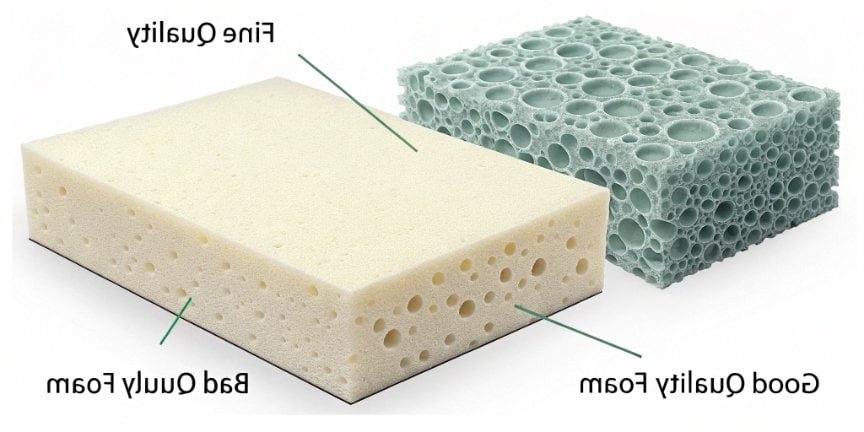
An accurate ratio is crucial for the chemical reaction to complete correctly. Even a small error affects foam density, hardness, cell structure, and cure time. This leads to product defects, performance failures, and increased raw material waste, directly impacting your profit and reputation.
Think of it like a recipe. If you use too much flour or not enough water, you don’t get bread; you get a mess. The same is true for foam. A few years ago, we were called in by a new client making automotive seats. They were facing a major issue with foam degrading too quickly. We investigated and found their old low-pressure machine had a ratio deviation of over 5%. That “small” error was the root cause of their quality crisis. After we installed one of our high-pressure machines, which holds the ratio with extreme precision, their problems disappeared. This is why we are so focused on metering accuracy. Your product’s performance and your company’s reputation depend on it.
The Impact of an Incorrect Ratio
Here is a simple breakdown of what happens when the ratio is wrong.
| Issue | Too Much Isocyanate (Off-Ratio High) | Too Little Isocyanate (Off-Ratio Low) |
|---|---|---|
| Physical Property | Foam becomes brittle, crumbly, and too hard. | Foam is soft, sticky, and may not cure properly. |
| Cell Structure | Coarse, irregular cells. May have large voids. | Poor cell formation, can lead to foam collapse. |
| Curing Time | May cure too fast and become scorched (burnt). | Very slow curing, or remains tacky indefinitely. |
| Performance | Poor resilience (doesn’t bounce back), low tear strength. | Low load-bearing capacity, poor dimensional stability. |
| Cost | Wastes expensive Isocyanate. High product reject rate. | Wastes Polyol. High reject rate and rework costs. |
What factors influence the ideal mixing ratio in high-pressure PU machines?
You’ve set the correct ratio on your PLC, but the foam is still inconsistent. This is frustrating and makes you doubt your equipment or your materials. Other factors can influence the final outcome.
Beyond the chemical formulation, the ideal mixing ratio can be influenced by material temperature, ambient humidity, and the types of additives used. These factors affect reaction speed and viscosity, sometimes requiring minor adjustments to the ratio to achieve consistent, perfect foam quality.

A high-pressure machine gives you control, but you have to know what to control. The ratio is just one piece. The process environment plays a huge role in the final chemical reaction.
1. Raw Material Temperature
Temperature directly affects the viscosity (thickness) and reactivity of your chemicals.[^6] Colder materials are thicker, flow slower, and react more slowly. Hotter materials are thinner and react much faster. If the Polyol and Isocyanate are at different temperatures, it can throw off the reaction balance even if the weight ratio is correct. That’s why our machines have built-in heat exchangers and sensors to keep both components at the precise temperature (usually around 22-25°C) your formulation requires, maintaining it within ±1°C.
2. Ambient Conditions
Isocyanate reacts with water.[^7] This includes moisture in the air (humidity). In very humid production environments, some of the isocyanate can react with airborne water instead of the polyol. This side reaction produces extra CO2 gas, which can make the foam less dense than intended. In these cases, a very small adjustment to the ratio might be needed to compensate. This is an advanced technique, and we help train our clients’ operators to spot these issues.
3. Additives and Catalysts
Your formulation is more than just Polyol and Isocyanate. It includes catalysts to control reaction speed, surfactants to stabilize cells, and sometimes additives like flame retardants or colorants. The ratio provided by your chemical supplier already accounts for these. However, if you decide to change a catalyst or add something new, you are changing the formulation. You must consult your supplier, as the ratio may need to be recalculated. We always advise our clients to test any new formula in a small batch before starting a full production run.
Conclusion
Achieving the correct PU foam mixing ratio requires a precise machine, the right formulation, and tight process control. We provide all three to ensure your production line works.
[^1]: “Polyurethane – Wikipedia”, https://en.wikipedia.org/wiki/Polyurethane. Polyurethane chemistry references describe the reaction of isocyanate groups with hydroxyl groups in polyols to form urethane linkages, supporting the molecular basis for the mixing ratio. Evidence role: mechanism; source type: encyclopedia. Supports: The polyol-isocyanate ratio determines how molecules link to form polyurethane polymer..
[^2]: “Polyurethane Foams: Past, Present, and Future – PMC”, https://pmc.ncbi.nlm.nih.gov/articles/PMC6213201/. Technical and academic descriptions of flexible polyurethane foam characterize it as an open-cell, resilient material used in cushioning applications, supporting the stated properties for flexible foam. Evidence role: definition; source type: education. Supports: Flexible polyurethane foam is typically soft, open-cell, and resilient.. Scope note: The source would support typical flexible foam characteristics, not the exact ratio range listed in the same table row.
[^3]: “Thermal conductivity of a polyurethane foam from 95 K to 340 K”, https://nvlpubs.nist.gov/nistpubs/Legacy/IR/nbsir82-1664.pdf. Building-science and materials references identify rigid polyurethane foam as a closed-cell insulation material with low thermal conductivity, supporting its description as hard and insulating. Evidence role: definition; source type: government. Supports: Rigid polyurethane foam is hard, closed-cell, and used for thermal insulation.. Scope note: The evidence supports common rigid foam properties but may not address all product-specific formulations.
[^4]: “Relationship between a pressure redistributing foam mattress …”, https://pmc.ncbi.nlm.nih.gov/articles/PMC7652312/. Biomedical or materials sources describe viscoelastic polyurethane foam as a slow-recovery cushioning material that redistributes pressure, supporting the stated memory-foam characteristics. Evidence role: definition; source type: paper. Supports: Memory foam is associated with slow recovery and pressure relief.. Scope note: Pressure relief can depend on foam design, body loading, and test conditions, so the support is contextual rather than universal.
[^5]: “Programmable logic controller”, https://en.wikipedia.org/wiki/Programmable_logic_controller. Industrial automation references define programmable logic controllers as rugged digital controllers used to automate industrial processes and machinery, supporting their role as central machine controllers. Evidence role: definition; source type: encyclopedia. Supports: A PLC functions as the central controller in industrial machinery such as high-pressure PU machines.. Scope note: This supports the general role of PLCs in industrial machinery, not the design of the specific PU machine described.
[^6]: “7. Chemical Kinetics”, https://faculty.washington.edu/jcv2/CHEM452_WI2023/html/chemical_kinetics.html. Polymer processing and chemical kinetics references show that liquid viscosity and reaction rates are temperature-dependent, supporting the claim that material temperature affects PU component flow and reactivity. Evidence role: mechanism; source type: paper. Supports: Temperature affects the viscosity and reactivity of polyurethane raw materials.. Scope note: The evidence is general to chemical processing unless paired with a polyurethane-specific source.
[^7]: “Effect of Catalysts on the Kinetics of the Water-toluene …”, https://scholarsmine.mst.edu/chem_facwork/1473/. Polyurethane chemistry references describe the reaction of isocyanates with water to form unstable carbamic acid that decomposes to amine and carbon dioxide, supporting the humidity-related side reaction discussed in the article. Evidence role: mechanism; source type: education. Supports: Isocyanate reacts with water, including moisture, and can generate CO2 in polyurethane systems..
Leave a Reply