

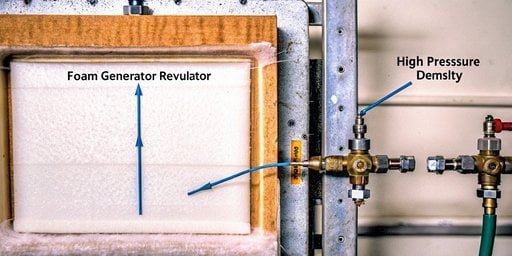
Struggling with foam density? You’re probably tweaking machine settings, but nothing works. The secret isn’t in the machine’s controls, but in the raw materials themselves.
A high-pressure machine doesn’t directly control foam density. Density is determined by the chemical formulation of your raw materials (polyol and isocyanate). The machine’s job is to precisely mix these materials at a preset ratio, ensuring a consistent reaction that produces the target density.

This might sound surprising. As an engineer in this industry for nearly 20 years, I’ve seen many clients believe the machine is a magic box for density. But it’s really a high-precision tool. Its purpose is to execute a recipe perfectly, not to create the recipe. To really understand this, we need to look at what the machine actually does and what it doesn’t do. Let’s break down the process step by step.
What mechanisms are used by high-pressure machines to regulate foam density?
Your machine has many controls and you believe they regulate density. But they don’t. These mechanisms are designed for precision and consistency, not for changing the foam’s fundamental properties.
High-pressure machines don’t have mechanisms to “regulate” density. Instead, they have systems to ensure it. These are high-precision metering pumps and a self-cleaning mixing head. They guarantee the correct ratio and complete mixing of chemicals, which allows the predetermined density to be achieved consistently.

The main job of a high-pressure machine is to be incredibly precise and repeatable. It is not designed to be an adjustment tool for density. The real work is done by two core components.
The Role of Metering Pumps
The heart of the machine is its metering pumps. These are not ordinary pumps. They are high-precision axial piston pumps, capable of delivering an exact volume of liquid with an accuracy of ±0.5%[^1]. When your chemical supplier tells you to use a ratio of 100:110, the pumps are calibrated to deliver exactly that. This unwavering precision means the chemical reaction happens correctly every single time, which is the foundation for consistent foam.
The Importance of the Mixing Head
After the pumps measure the materials, they are sent to the mixing head. Here, they are forced through small nozzles at high pressure (120-200 bar). This causes the two streams to collide with immense force, a process called impingement mixing[^2]. This turbulence creates a perfectly homogenized mixture in milliseconds. A good mix ensures a uniform cell structure and consistent density throughout the final product.
| Mechanism | Function | Impact on Density |
|---|---|---|
| Metering Pumps | Precisely measure and deliver raw materials. | Ensures the target density is met consistently. |
| Mixing Head | Forcefully mixes materials via high-pressure impingement. | Creates a uniform reaction, preventing density variations. |
How do mixing ratios in a high-pressure machine affect the final foam density?
Adjusting the mixing ratio seems like the obvious way to change density. But in my experience, this often leads to bad foam and big headaches. The ratio’s real purpose is to achieve a perfect chemical reaction.
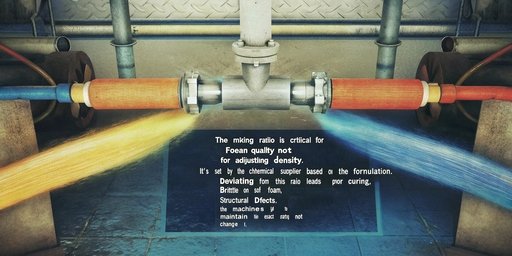
The mixing ratio is critical for foam quality, not for adjusting density. It’s set by the chemical supplier based on the formulation. Deviating from this ratio leads to poor curing, brittle or soft foam, and structural defects. The machine’s job is to maintain this exact ratio, not change it.
I often talk to production managers like Mr. Hieu in Vietnam. He understands machines, but the chemistry can be a black box. The mixing ratio is the key to unlocking that box, but you must use it correctly.
What the Ratio Represents
The mixing ratio is a chemical recipe, not a machine setting you should change on a whim. It is determined by the molecular weight of the polyol and isocyanate. A ratio like 100 parts polyol to 110 parts isocyanate (by weight) is calculated to ensure a complete reaction, where all molecules find a partner. This is called a stoichiometric balance. Your machine’s only job is to lock in and maintain this balance.
Consequences of Incorrect Ratios
Changing the ratio is called “off-ratio foaming,” and it always ends badly. If you add too much isocyanate, you get an “isocyanate-rich” foam. It will be hard, brittle, and often scorched or burnt. If you add too little isocyanate (or too much polyol), you get a “polyol-rich” foam. This foam will be soft, wet, and may never cure properly, leading to collapse. The machine’s value is its ability to prevent these problems by being incredibly consistent.
| Ratio Status | Result | Foam Quality |
|---|---|---|
| Correct Ratio (e.g., 100:110) | Complete chemical reaction. | Strong, stable, correct density. |
| Off-Ratio (Too much ISO) | Incomplete reaction, excess Isocyanate. | Brittle, scorched, unstable. |
| Off-Ratio (Too little ISO) | Incomplete reaction, excess Polyol. | Soft, wet, poor curing. |
What role does temperature and pressure play in controlling foam density in high-pressure systems?
You see pressure gauges and temperature controls all over your machine. So you assume they must control density, right? Their job is actually to create the ideal conditions for the reaction, not define the outcome.
Temperature and pressure don’t control density, but they are crucial for a stable process. Correct temperatures ensure the raw materials have the right viscosity for pumping and mixing. High pressure is used to atomize and mix the chemicals effectively, not to compress the foam.

Think of temperature and pressure as support systems. They help the chemicals do their job correctly. Without them, even the best machine and the best formula will fail.
Temperature’s Role: Viscosity and Reactivity
Temperature control is vital because it directly affects the viscosity (or thickness) of your chemicals. We equip our machines with heat exchangers and insulated tanks to keep the polyol and isocyanate at a stable temperature, usually around 22-25°C. If the materials get too cold, they become thick like honey. This makes them hard to pump accurately and mix properly. If they are too hot, their reactivity increases, and the foaming process can become too fast and uncontrollable. Stable temperature means stable viscosity, which leads to a stable process.
Pressure’s Role: Mixing Efficiency
The “high pressure” in the machine’s name is all about mixing. We use pressures between 120 and 200 bar (1740-2900 psi) to shoot the liquids into the mixing head. This high pressure forces the liquids through tiny orifices, causing them to atomize into a fine mist. When these mists collide, the mixing is instant and total. This ensures that the reaction is uniform across the entire shot, which is essential for consistent foam. The pressure does not compress the foam or determine its density; it just creates the perfect mix.
| Parameter | Function | Why It’s Important |
|---|---|---|
| Temperature | Controls raw material viscosity. | Ensures stable pumping and consistent reactivity. |
| Pressure | Atomizes and mixes raw materials. | Guarantees a fast, thorough, and uniform chemical reaction. |
What adjustments can be made to a high-pressure machine to achieve the desired foam density?
So, what can you adjust on the machine to get your desired density? It can be frustrating to hear, but the answer is nothing. The real adjustment happens before the chemicals even enter the machine.
You cannot adjust the machine to change foam density. To achieve a different density, you must use a different raw material formulation. The machine is then calibrated to the new formulation’s specific ratio and viscosity, ensuring it produces the new target density consistently.

This is the most important concept I teach our clients. The power to control density lies with your chemical supplier, not your machine operator. Your machine is a tool for execution, not creation.
Changing the Formulation
The density of polyurethane foam is determined by the amount of blowing agent in the polyol blend. More blowing agent creates more gas during the reaction, which results in a lower density foam. Less blowing agent leads to a higher density foam. So, if you want to produce a 30 kg/m³ foam for a sofa back and a 50 kg/m³ foam for a seat cushion, you need two different chemical systems. You must tell your supplier what density you need, and they will provide the correct formulation.
Calibrating the Machine for the New Formula
Once you have the new chemical system, you then “adjust” the machine. This is a calibration process, not a creative one. You will program the machine’s PLC with the new mixing ratio that the supplier provided. You may also need to adjust the tank temperatures slightly if the new materials have a different ideal viscosity. After that, the machine takes over. Its job is to execute that new recipe with the same precision as before, guaranteeing you get the new density you wanted.
| To Achieve… | The Correct Action | The Incorrect Action |
|---|---|---|
| Higher Density Foam | Use a formulation with less blowing agent. | Increasing machine pressure or changing the ratio. |
| Lower Density Foam | Use a formulation with more blowing agent. | Lowering machine pressure or changing the ratio. |
Conclusion
Your high-pressure machine ensures consistent foam quality by perfectly mixing materials. But the density itself is controlled by your chemical formulation. Choose the right materials, and the machine will do the rest.
[^1]: “Polyurethane – Mahr Metering Systems”, https://metering.mahr.com/en-int/polyurethane. A machinery standard or technical reference on polyurethane metering systems can document typical dosing-accuracy ranges for high-pressure metering pumps. Evidence role: statistic; source type: other. Supports: High-pressure PU metering pumps can deliver components with very tight volumetric accuracy, claimed here as ±0.5%.. Scope note: The ±0.5% value is likely equipment-specific; a general source may only substantiate that high metering accuracy is required or typical, not this exact tolerance for all machines.
[^2]: “Impingement mixing in reaction injection molding”, https://experts.umn.edu/en/publications/impingement-mixing-in-reaction-injection-molding. Research literature on reaction injection molding and polyurethane processing defines impingement mixing as the high-velocity collision of reactant streams in a mixing chamber. Evidence role: definition; source type: paper. Supports: The described collision of high-pressure liquid streams is known as impingement mixing..


Leave a Reply