


Are you wondering if one machine can meet all your foam production needs? Buying separate lines for soft and rigid foam is expensive and inefficient, limiting your factory’s potential.
A high-pressure foaming machine can produce both soft (flexible) and rigid polyurethane foam. The final product depends entirely on the chemical raw materials (polyol and isocyanate) and their mixing ratio, not the machine itself. The machine’s job is to meter and mix them precisely.
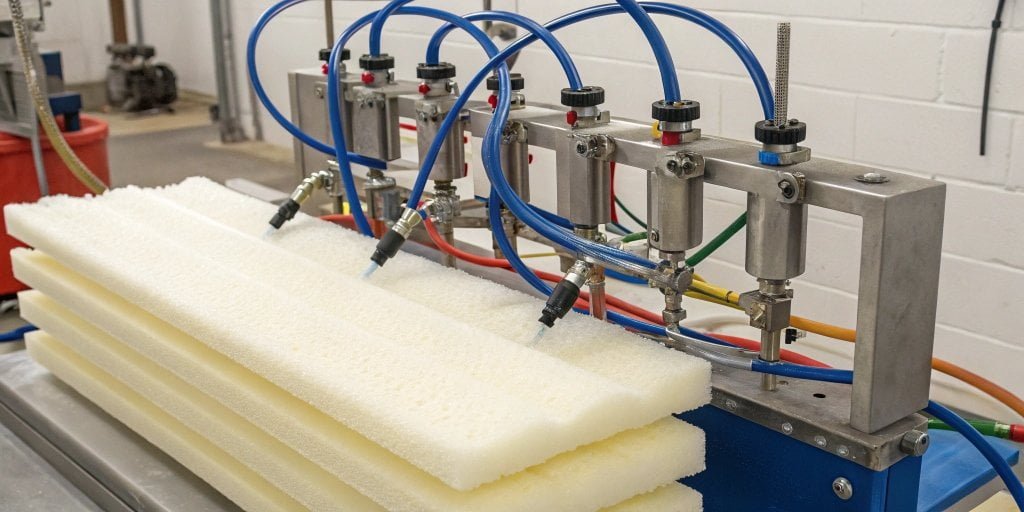
This flexibility is a game-changer for many manufacturers. A single investment can unlock multiple product lines, from sofa cushions to insulation panels. But how exactly does one machine manage such different materials and processes? It’s simpler than you might think, and it all comes down to smart engineering and customization. Let’s break down how it works, so you can see the possibilities for your own production floor.
Can a high-pressure machine produce both soft and rigid polyurethane foam?
You need to make both car seats and insulation panels. You think this requires two separate, expensive production lines. But what if one high-pressure machine could handle both jobs efficiently?
Yes, absolutely. A single high-pressure machine is versatile enough to produce both soft, flexible foams and hard, rigid foams. The key is adjusting the chemical formulation and ensuring the machine’s components, like pumps and mixheads, are configured for the correct chemical ratios.
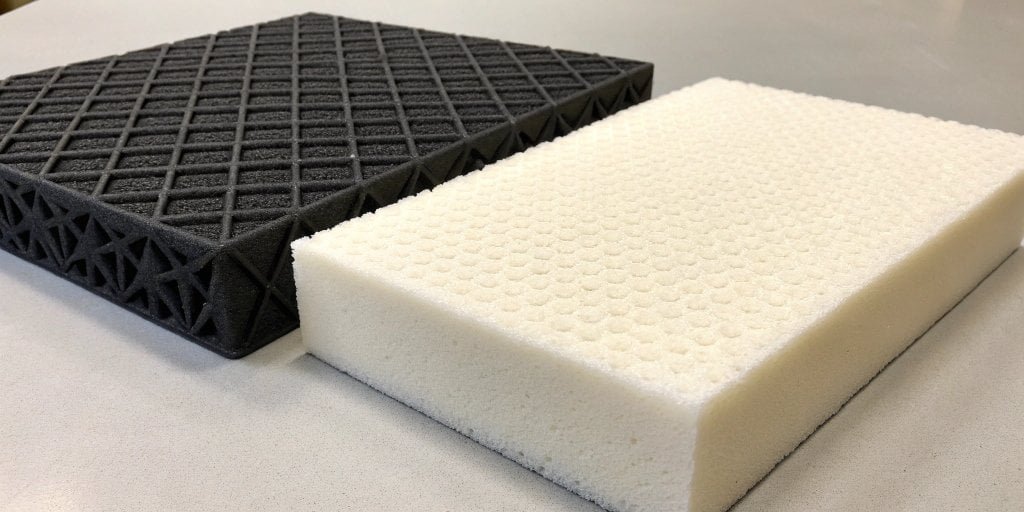
A high-pressure machine is simply a tool that delivers raw materials with extreme precision. The real magic happens in the chemistry. The type of foam you get—its density, cell structure, and hardness—is determined by the specific polyol, isocyanate, and additives you use.[^1] Our role at Foamor is to provide a machine that can handle whatever formulation you need. Think of it like a professional kitchen oven; it can bake a soft, delicate cake or a hard, crusty bread. The oven provides the precise heat control, but the ingredients determine the final product. Similarly, our machine provides precise ratio and mixing control, allowing you to create a wide range of foam products. The machine doesn’t decide; your chemical recipe does.
Soft Foam vs. Rigid Foam: The Chemical Difference
| Feature | Soft (Flexible) Foam | Rigid Foam |
|---|---|---|
| Main Polyol | Polyether Polyol (long, flexible chains)[^2] | Polyester or Polyether Polyol (short, branched chains) |
| Main Isocyanate | Toluene Diisocyanate (TDI)[^3] | Polymeric Methylene Diphenyl Diisocyanate (pMDI)[^4] |
| Cell Structure | Open-cell (allows air to pass through)[^5] | Closed-cell (traps gas for insulation)[^6] |
| Primary Use | Cushioning, Comfort | Insulation, Structure |
How does a high-pressure foaming machine adapt to different types of foam production?
You have a machine set up for rigid foam, but a new opportunity requires soft foam. Are you stuck with a single-purpose machine? Adapting your equipment is completely possible with the right initial design.
A high-pressure machine adapts to different foams mainly through its metering system and software controls. We customize the pump sizes based on your required chemical ratios. For example, soft foam often needs a much larger polyol-to-isocyanate ratio, requiring different pump sizes to deliver materials accurately.
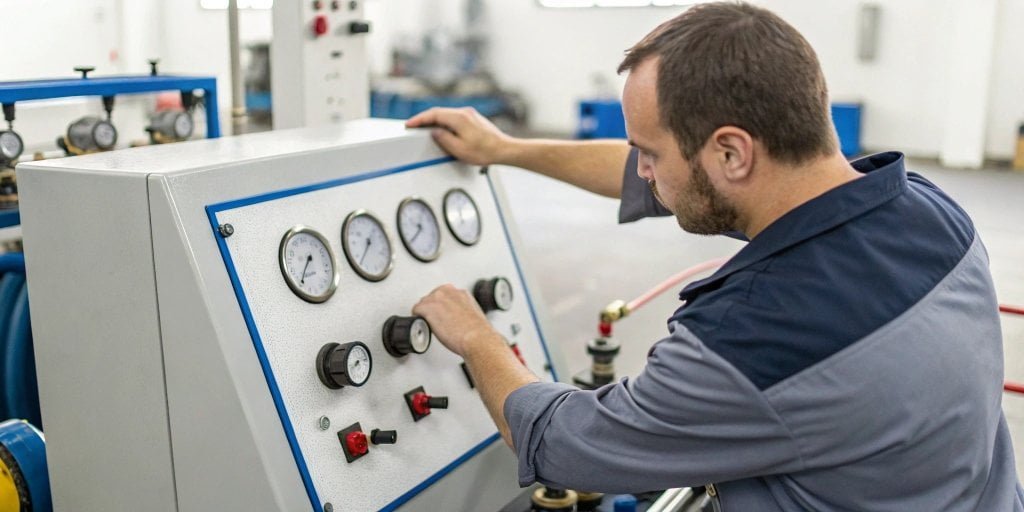
Adaptability is built into the machine’s design from day one. When a new client, like Nguyen Van Hieu from a furniture factory in Vietnam, comes to us, we don’t just sell him a standard machine. We ask, “What products do you want to make now, and what might you make in the future?” Based on his answer, we configure the machine for maximum flexibility.
Key Areas of Machine Customization
- Pump Configuration: The heart of adaptation is the pump system. The ratio of polyol to isocyanate is very different for soft and rigid foams.
- Rigid Foam: Often uses a ratio close to 1:1. This means we can use two pumps of the same size, which simplifies the design.
- Soft Foam: Can have ratios from 2:1 to 5:1. This requires a larger pump for the polyol and a smaller one for the isocyanate. We engineer the machine with the right pump combination for your specific formulas.
- Mixing Head: Our high-pressure machines use self-cleaning mixing heads. This is crucial. After each injection, pistons clean the mixing chamber completely. This means you can switch from a rigid foam formula to a soft foam formula without residue contamination, ensuring pure, high-quality output every time.
- Temperature Control: Different polyols require different operating temperatures. Our machines come with independent heating and cooling systems for each material tank, allowing you to set the perfect conditions for whatever chemical system you are using.
How stiff is high density foam?
Many people hear “high-density” and assume it means “rock-hard.” This common confusion can lead to choosing the wrong foam for your product. But the truth is, density and stiffness are two different properties.
Stiffness is not directly determined by density. A high-density foam can be very soft (like premium memory foam) or extremely rigid (like structural foam). Stiffness (or hardness) is a separate measurement related to the foam’s chemical structure and how it resists compression.

Let’s clear this up once and for all. Density simply measures how much material is packed into a certain volume (measured in kg/m³ or lb/ft³). A higher density often means more durability and support, but not necessarily more stiffness. For example, the high-density memory foam in a luxury mattress is designed to be soft and contouring. In contrast, a lower-density rigid foam used for packaging might feel much harder because its purpose is to be stiff and protective. When we discuss foam with our clients, we always clarify both density and the required stiffness (measured as Indentation Force Deflection for soft foams or compressive strength for rigid foams[^7]) to ensure the final product meets their exact performance needs.
Understanding Density vs. Stiffness
| Foam Type | Density (kg/m³) | Stiffness / Hardness | Common Application |
|---|---|---|---|
| Memory Foam | High (50-80) | Soft (Low IFD) | Mattresses, Pillows |
| HR (High Resilience) Foam | Medium (35-50) | Firm (High IFD) | Sofa Cushions, Car Seats |
| Rigid Insulation Foam | Low (30-40) | Rigid (Good Compressive Strength) | Wall Panels, Refrigerators |
| Structural Rigid Foam | High (60-200+) | Very Rigid (High Compressive Strength) | Faux Wood Beams, Automotive Parts |
What are the typical applications for soft vs. rigid foam produced by a high-pressure machine?
You have a high-pressure machine, or are considering one. Are you aware of all the markets you could enter? The possibilities with both soft and rigid foam are nearly endless.
Soft foams like flexible and HR foam are used in furniture, automotive seating, and mattresses. Rigid foams are essential for building insulation, refrigerator panels, and decorative faux wood moldings. A high-pressure machine produces the high-quality, consistent foam needed for all these demanding applications.

With one versatile machine, you can serve multiple industries. We work with clients who start in one area and expand into another. I remember a customer in the Middle East who initially bought our machine to make decorative crown molding (rigid foam). A year later, they saw a local opportunity in manufacturing office chairs and came back to us. Because their machine was designed with flexibility in mind, we helped them source the right soft foam chemicals and remotely adjusted their machine’s parameters. They were able to launch a new product line without buying a new machine. This is the power of a truly adaptable system.
Common Markets for PU Foam
Soft Foam Applications
- Furniture & Bedding: Sofa cushions, mattresses, and pillows using HR foam and memory foam.
- Automotive: Car seats, headrests, armrests, and dashboards using molded flexible and integral skin foam.
- Footwear: Midsoles and insoles that provide cushioning and support.
- Specialty: Sound-absorbing panels, sponges, and medical positioning pads.
Rigid Foam Applications
- Construction & Building: Thermal insulation boards for walls and roofs, spray foam insulation, and pipe insulation.
- Appliances: High-efficiency insulation for refrigerators and freezers.
- Decorative: Faux wood beams, door frames, and architectural moldings that are lightweight and easy to install.
- Industrial & Marine: Structural components, flotation devices, and custom protective packaging.
Conclusion
A high-pressure machine is not limited to one foam type. It is a versatile tool for producing both high-quality soft and rigid foam, opening up diverse markets for your business.
[^1]: “Mechanical Properties of Polyurethane Foam Reinforced …”, https://www.mdpi.com/2504-477X/8/9/343. Polyurethane foam references describe how polyol structure, isocyanate type, catalysts, surfactants, blowing agents, and other additives influence density, cell morphology, and mechanical properties; this supports the formulation-property relationship, with the caveat that processing conditions also contribute. Evidence role: mechanism; source type: research. Supports: Polyurethane foam density, cell structure, and hardness are influenced by the selected polyol, isocyanate, and additives.. Scope note: The evidence is contextual because it supports formulation influence, not exclusive determination by formulation alone.
[^2]: “A STUDY OF SLABSTOCK FLEXIBLE POLYURETHANE …”, https://vtechworks.lib.vt.edu/server/api/core/bitstreams/6aecb22c-e007-40b3-b6ab-c028e77e5513/content. Polyurethane materials references identify polyether polyols as common precursors for flexible polyurethane foams because their molecular structures can provide flexible soft segments; this supports the table entry as a simplified generalization rather than a rule for all flexible foams. Evidence role: definition; source type: encyclopedia. Supports: Polyether polyols with flexible chain segments are commonly used in flexible polyurethane foam formulations.. Scope note: Some flexible polyurethane foams may use other polyol chemistries or blends, so the support is not absolute.
[^3]: “CDC – NIOSH Pocket Guide to Chemical Hazards – Toluene-2,4 …”, https://www.cdc.gov/niosh/npg/npgd0621.html. Authoritative chemical and polymer references describe toluene diisocyanate as a major isocyanate used in flexible polyurethane foam manufacture; this supports the table’s association of TDI with flexible foam, while not excluding MDI-based flexible systems. Evidence role: definition; source type: government. Supports: TDI is a common isocyanate used in flexible polyurethane foam production.. Scope note: The source should be treated as supporting common use, not exclusive use.
[^4]: “Diphenylmethane diisocyanate | C15H10N2O2 – PubChem”, https://pubchem.ncbi.nlm.nih.gov/compound/Diphenylmethane-diisocyanate. Institutional chemical references identify polymeric MDI as widely used in rigid polyurethane foam insulation and related applications; this supports the table’s association of pMDI with rigid foam but does not imply it is the only isocyanate used. Evidence role: definition; source type: government. Supports: Polymeric MDI is commonly used in rigid polyurethane foam production.. Scope note: Supports common industrial use, not an exclusive formulation requirement.
[^5]: “Which Spray Foam Is Right For You?”, https://www1.eere.energy.gov/buildings/publications/pdfs/building_america/spray_foam_guide.pdf. Building-science and materials references distinguish open-cell foams, which have interconnected pores that permit air movement, from closed-cell foams; this supports the table’s explanation of open-cell structure in general terms. Evidence role: definition; source type: education. Supports: Open-cell foam has interconnected cells that allow air to pass through.. Scope note: Air permeability varies by foam formulation, density, and skin formation, so the statement is general rather than product-specific.
[^6]: “Which Spray Foam Is Right For You?”, https://www1.eere.energy.gov/buildings/publications/pdfs/building_america/spray_foam_guide.pdf. Energy-efficiency and building-science sources explain that closed-cell polyurethane foam contains gas-filled cells that reduce heat transfer and contribute to insulation performance; this supports the table entry while not quantifying insulation value for a specific foam. Evidence role: mechanism; source type: government. Supports: Closed-cell rigid foam traps gas in cells, which contributes to thermal insulation.. Scope note: The evidence is general and does not establish thermal performance for any particular product or formulation.
[^7]: “On the Compressive Response of Polymeric Cellular Materials”, https://pmc.ncbi.nlm.nih.gov/articles/PMC7014359/. ASTM and ISO foam test methods define indentation force deflection as a hardness test for flexible cellular materials and compressive strength as a mechanical test for rigid cellular plastics; this supports the measurement distinction but not any particular performance threshold. Evidence role: definition; source type: institution. Supports: Soft foam hardness is commonly measured by indentation force deflection, while rigid foam mechanical resistance is commonly measured by compressive strength.. Scope note: The source supports test-method terminology, not specific values for the article’s example products.



Leave a Reply