

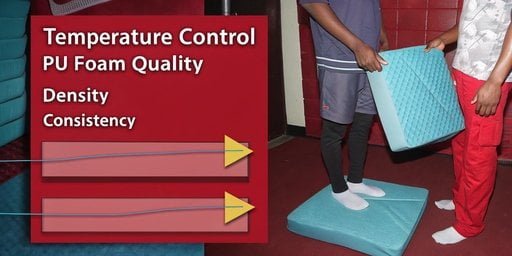
Struggling with inconsistent foam quality? This leads to wasted materials and unhappy customers. The secret to stable, high-quality foam production lies in mastering temperature control.
Temperature control is critical for polyurethane foam quality. It directly influences the reaction speed, viscosity, and mixing efficiency of the raw materials. Proper temperature ensures a stable reaction, leading to consistent density, cell structure, and physical properties in the final product.
You now know that temperature is a big deal in foam production. But how does it specifically impact your final product, day in and day out? Let’s dive deeper into the specific ways temperature changes can either help or hurt your foam quality and what you can do to manage it effectively.
What is the impact of temperature control on the quality of polyurethane foam?
Seeing defects like cracks and soft spots in your foam? These quality issues lead directly to rejected products and higher costs. The impact of temperature is the root cause.
The impact is huge. Temperature controls the reaction rate of polyol and isocyanate. Too hot, the reaction is too fast, causing defects. Too cold, it’s too slow, resulting in poor mixing and incomplete curing. Stable temperature ensures a predictable, complete reaction for optimal foam quality.

Temperature is the engine that drives the chemical reaction between your A-component (Isocyanate) and B-component (Polyol). For most furniture or automotive foam applications, the ideal temperature for these materials is around 25°C. This is the sweet spot for a controlled reaction.
Reaction Speed (Kinetics)
If your materials get too warm, the reaction happens too quickly. The foam mixture might start to gel before it has time to flow and fill the entire mold. This can create empty pockets (voids) or cause the foam to become brittle and shrink.
Material Viscosity
If your materials are too cold, they become thicker, like cold oil.[^1] This high viscosity makes it very difficult for the mixing head to blend them properly. This poor mixing leads to an unstable foam structure.[^2] You might see large, uneven cells, soft spots, or even areas where the foam collapses completely because the reaction was incomplete.
| Temperature | Impact on Reaction | Potential Defect |
|---|---|---|
| Too High (>30°C) | Too fast, premature gelling | Voids, shrinkage, brittle foam |
| Optimal (22-28°C) | Controlled, stable reaction | Consistent cell structure, good density |
| Too Low (<20°C) | Too slow, poor mixing | Soft spots, large cells, collapse |
How does maintaining the correct temperature improve PU foam consistency and performance?
Are your foam products inconsistent from one batch to the next? This unpredictability makes it hard to meet strict client specifications. Maintaining a stable temperature ensures repeatable quality every time.
Correct temperature ensures every batch uses materials with the same viscosity and reactivity. This leads to predictable cream time, gel time, and rise time. The result is consistent density, hardness, and cell structure, ensuring every product meets your performance standards and your client’s expectations.

When we help clients set up their production lines, our main goal is to achieve consistency. Temperature control is the foundation of that consistency. For clients who supply to big companies like IKEA, every cushion must feel and perform exactly the same.
Predictable Production Cycles
A stable material temperature ensures that your key process times are always the same. Your cream time (when the mix starts to expand), gel time (when it turns solid), and tack-free time (when it’s no longer sticky) become predictable.[^3] This allows your operators to run a standardized process for every single part, which reduces errors and makes your entire production schedule more reliable.
Enhanced Physical Properties
The final physical properties of the foam depend directly on a complete and proper reaction. By controlling the temperature, you control the outcome. This means you can reliably produce foam with the correct density, hardness (IFD), tear strength, and resilience. Every part that comes out of the mold will meet the technical specifications you promised to your customer.
| Process Parameter | Controlled by Temperature | Result of Stability |
|---|---|---|
| Cream Time | Yes | Consistent start of foaming |
| Gel Time | Yes | Predictable mold handling time |
| Density | Yes | Uniform product weight and support |
| Hardness (IFD) | Yes | Consistent feel and performance |
What are the consequences of improper temperature regulation in PU foam production?
Do you discard a lot of foam because of defects? This waste directly hurts your profits and delays shipments. These costly issues are often caused by improper temperature regulation.
Consequences include wasted raw materials, high scrap rates, and inconsistent product quality. You’ll see defects like foam collapse, large voids, shrinkage, and poor surface finish. This can lead to customer complaints, rejected orders, and damage to your brand’s reputation. It also increases production costs.

Ignoring temperature is one of the most expensive mistakes you can make in foam production. I have visited factories where the scrap rate was over 15% simply because the ambient temperature changed from morning to afternoon, and their old equipment couldn’t compensate for it.
Material Waste and Financial Loss
When the temperature is wrong, you get bad parts. A reaction that is too cold can cause the foam to collapse. A reaction that is too hot can cause the foam to shrink after demolding. In both cases, the part is useless and must be thrown away. With the rising cost of polyol and isocyanate, this waste directly reduces your profit on every single product you make.
Production Inefficiency
Bad temperature control also slows down your entire factory. Your team will waste time trying to figure out why the foam quality has suddenly changed. They may have to stop production to clean a mixing head that has clogged due to a premature reaction. All these small stops and problems add up, reducing your total output and making it difficult to meet shipping deadlines for your customers.
| Problem | Cause (Temperature) | Consequence |
|---|---|---|
| Foam Collapse | Too cold, slow reaction | Total material loss |
| Shrinkage | Too hot, fast reaction | Part does not fit specifications |
| Hard Skin | Too hot, surface cures too fast | Brittle, poor appearance |
| Soft Spots | Too cold, poor mixing | Inconsistent performance, part fails |
How can high-pressure machines ensure precise temperature control during the foaming process?
Your old machine lacks temperature control, right? This means you’re stuck with inconsistent quality and high waste. Modern high-pressure machines solve this with integrated heating and cooling systems.
High-pressure machines feature a closed-loop temperature control system. It includes heaters and chillers for the raw material tanks and pipelines. Sensors constantly monitor the temperature, automatically adjusting to keep the polyol and isocyanate at the precise setpoint (e.g., 25°C) before mixing.
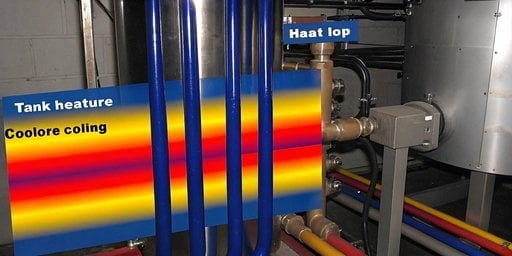
This is the biggest advantage of upgrading from an old low-pressure machine to a modern high-pressure system. Our Foamor machines are designed with total process control in mind, and temperature is at the center of that.
Integrated Tank and Line Control
Our high-pressure machines come with double-jacketed material tanks. We circulate temperature-controlled water in the outer jacket to either heat or cool the chemicals inside. You simply set your desired temperature on the touch screen, and the machine does the rest. Sensors in the tanks and all the way to the mixhead constantly check the temperature and tell the system to make adjustments. This ensures the materials are perfect right at the moment of injection.
Post-Mixing Heat Acceleration
Control doesn’t stop once the material is mixed. The mold temperature is also very important. We often pair our machines with a mold temperature controller. This unit heats the mold to a stable temperature, for example 45-60°C. Injecting the foam mixture into a heated mold speeds up the final curing reaction. This lets you demold the part faster, which means you can produce more parts per hour with the same mold.
| Machine Feature | Function | Benefit for User |
|---|---|---|
| Jacketed Tanks | Heats/cools raw materials in the tank | Stable material temperature all day |
| Sensors & PLC | Monitors and adjusts temp automatically | Precise, hands-free process control |
| Mold Temperature Controller | Heats the mold to a set temperature | Faster curing times, higher productivity |
Conclusion
Precise temperature control is not optional; it is essential for high-quality PU foam. It guarantees consistency, reduces waste, and boosts product performance, securing your production and your profits.
[^1]: “Temperature effects on the rheological properties of current …”, https://pubmed.ncbi.nlm.nih.gov/12886208/. Rheology references and polyol data support that liquid viscosity generally increases as temperature decreases, including for polymeric liquids used in polyurethane systems; this supports the analogy but not a specific viscosity value. Evidence role: mechanism; source type: paper. Supports: Lower temperature increases the viscosity of polyurethane raw materials such as polyols.. Scope note: The magnitude of viscosity change depends on the chemical grade and additives in the component.
[^2]: “A Review of Research on the Effect of Temperature on … – PMC”, https://pmc.ncbi.nlm.nih.gov/articles/PMC9654075/. Polyurethane foam studies indicate that mixing quality affects nucleation, cell development, and foam morphology; this supports the mechanism generally, while specific outcomes depend on formulation and equipment. Evidence role: mechanism; source type: paper. Supports: Poor mixing of polyurethane components can lead to unstable or nonuniform foam structure.. Scope note: Foam structure is also influenced by surfactants, catalysts, blowing agents, pressure, and mold conditions.
[^3]: “D7487 Standard Practice for Polyurethane Raw Materials”, https://www.astm.org/d7487-18.html. Standard polyurethane foam characterization describes cream time, gel time, rise time, and tack-free time as process indicators affected by formulation and processing conditions including temperature; this supports the role of stable conditions in repeatability rather than guaranteeing identical timing. Evidence role: definition; source type: institution. Supports: Stable temperature helps make polyurethane foam process times such as cream time, gel time, and tack-free time more repeatable.. Scope note: Predictability also requires stable metering ratio, catalyst concentration, moisture level, and mixing energy.

Leave a Reply