

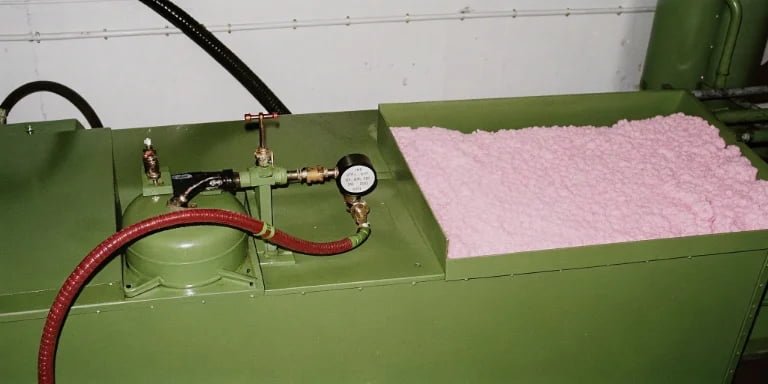
Confused by the term “high pressure” in PU foam machines? This confusion can lead to buying the wrong equipment, wasting your investment. Let’s clear up what it really means.
“High pressure” in a PU foaming machine refers to the force applied to the raw materials (polyol and isocyanate) right before they mix. It’s not about the machine’s hydraulic system. This high-pressure injection creates a perfect, solvent-free mix, leading to higher-quality foam.
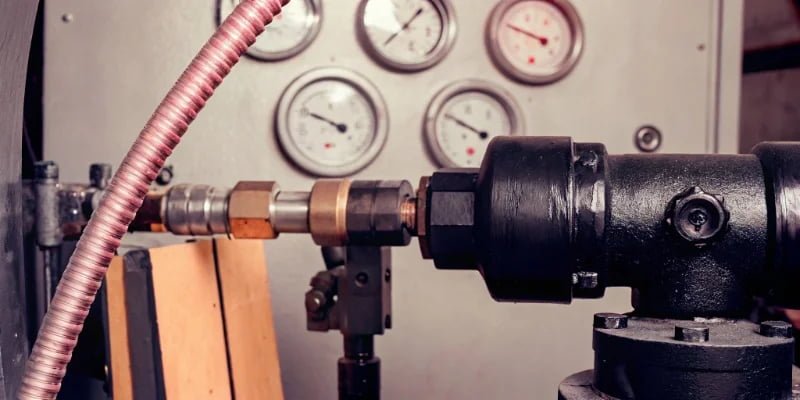
Many people I talk to, especially those new to PU foaming, get this wrong. They see the machine has a hydraulic station and assume that’s where the “high pressure” for foaming comes from. But that’s a common misunderstanding. The hydraulic station is just there to provide power for other functions, like opening and closing the mixing head’s cleaning piston or switching valves. The real magic of “high pressure” happens somewhere else entirely. In this post, I will walk you through exactly what this term means, how it works, and why it is so critical for the quality of your final product.
What is the significance of “high pressure” in high-pressure PU foaming machines?
You know “high pressure” is a key feature, but struggle to see its direct value. This makes it hard to justify the higher cost. Understanding its significance shows why it’s a game-changer.
The real significance lies in the mixing quality. High pressure atomizes the raw materials, forcing them to collide and mix instantly at a molecular level. This powerful mixing action eliminates the need for chemical flushing solvents and results in a more uniform, stable, and strong foam structure.
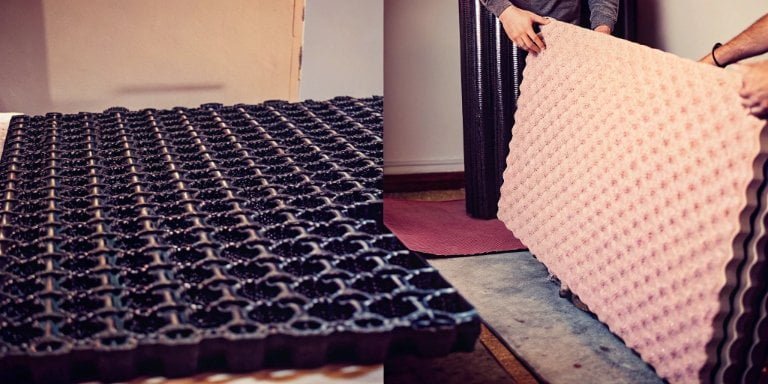
The Core of the Matter: Impingement Mixing
The process is called “high-pressure impingement mixing.”[^1] Think of it like this: two streams of material, the Polyol (A) and Isocyanate (B), are shot at each other inside a tiny mixing chamber. They travel at extremely high speeds because they are under immense pressure, typically between 100 to 200 bar[^2] (that’s over 1450 PSI!). When these two jets collide head-on, the intense turbulence forces them to mix perfectly and instantly without any mechanical stirrer[^3]. This is completely different from a low-pressure machine, which uses a spinning mixer blade[^4], much like a cake mixer. This method is not only more effective but also cleaner.
| Feature of High-Pressure Mixing | Direct Benefit for Your Production |
|---|---|
| Instant Molecular Mixing | Creates a complete chemical reaction for stronger foam. |
| No Mechanical Stirrer | Eliminates one potential point of failure and cleaning. |
| Self-Cleaning Head | No need for flushing solvents[^5], which saves money and is better for the environment. |
| Uniform Cell Structure[^6] | Results in consistent density and superior physical properties like resilience and durability. |
How does high pressure affect the performance of PU foaming machines?
Is your current foam quality inconsistent, leading to too many rejected parts? This wastes raw materials, costs you time, and can damage your reputation with clients. High pressure directly solves this by boosting machine performance.
High pressure dramatically improves a machine’s performance by ensuring precise ratio control and superior mixing. This leads to consistent foam density, better cell structure, and fewer defects. It also allows for faster production cycle times because the mixing is instant and the mixing head is self-cleaning.

Precision and Consistency
High-pressure systems use high-precision metering pumps, often axial piston pumps[^7]. These pumps are incredibly accurate, ensuring the mix ratio of your A and B components is perfect with every single shot, with a precision of ±0.5%[^8]. This level of control is simply not achievable with the gear pumps found in most low-pressure machines. When the ratio is right, the chemical reaction is perfect. This means you get the exact foam properties you designed, every single time, from the first part of the day to the last. This consistency is crucial for meeting the strict quality standards of customers like IKEA or automotive companies.
Speed and Efficiency
The self-cleaning nature of the high-pressure mixing head is a huge performance booster. After each pour, a hydraulic piston inside the head pushes out any remaining mixed material, cleaning the chamber instantly. This means the machine is ready for the next shot in seconds. There’s no need to stop and flush the head with solvents, which is a slow, messy, and wasteful process required by low-pressure machines. For a factory producing thousands of furniture cushions or car seats a day, eliminating this downtime adds up to a massive increase in productivity and efficiency.
What is the difference between high-pressure and low-pressure PU foaming systems?
Choosing between a high-pressure and a low-pressure foaming system can be confusing. Making the wrong choice could lead to a wasted investment, production headaches, and products that don’t meet quality standards. Let’s make the choice clear.
The main difference is the mixing method and the resulting foam quality. High-pressure machines use high-velocity impingement mixing without a stirrer, creating superior foam. Low-pressure machines use a mechanical stirrer at lower pressures and require solvent flushing, making them simpler but less efficient and effective.
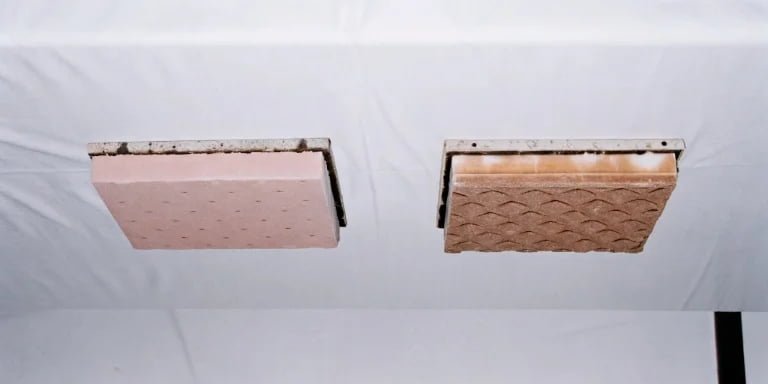
A Head-to-Head Comparison
I’ve worked with hundreds of clients, and the choice almost always comes down to their end-product requirements. For a client like Mr. Nguyen in Vietnam, whose furniture factory supplies to major European brands, upgrading from an old low-pressure machine to our high-pressure system was a necessary step to meet stricter quality demands and reduce material waste. The table below breaks down the differences simply.
| Feature | High-Pressure System | Low-Pressure System |
|---|---|---|
| Mixing Method | Impingement (material collision) | Mechanical Stirrer |
| Operating Pressure | 100 – 200 bar (at mixing head) | < 20 bar |
| Mixing Head | Self-cleaning (no solvents) | Requires solvent flushing |
| Foam Quality | Very uniform, fine cell structure | Less uniform, larger cells, potential for defects |
| Material Waste | Minimal | Higher (due to flushing and less precise mixing) |
| Best Applications | Automotive seats, high-end furniture, memory foam, integral skin | Rigid foam insulation, packaging, simple molded parts |
| Investment Cost | Higher | Lower |
Why is high pressure important in the polyurethane foaming process?
You want to produce top-tier PU foam products that your customers love. But if your current process results in defects like voids or inconsistent density, you’ll face complaints. High pressure is the key process variable that unlocks superior quality.
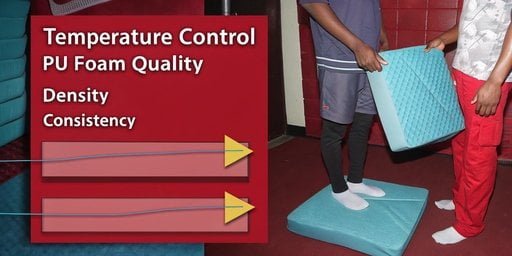
High pressure is crucial because it governs the quality of the chemical reaction itself. The intense, solvent-free mixing it creates ensures the polyol and isocyanate react completely and uniformly. This results in foam with optimal and reliable physical properties, including resilience, durability, and consistent density.
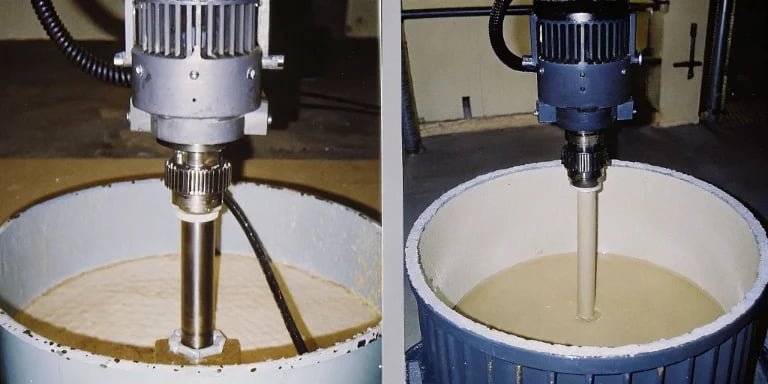
From Process to Product
At its heart, making polyurethane foam is about controlling a chemical reaction. The quality of that reaction determines the quality of your final product. Poor or incomplete mixing, which can happen with low-pressure systems, leads to an unstable reaction. This can create physical defects in the foam—soft spots, hard spots, or large air pockets (voids). These are not just cosmetic issues; they are structural failures that can lead to product returns and a damaged reputation. High pressure forces a perfect mix, which in turn creates a perfect, predictable reaction every time.
Meeting Strict Standards
This control is why high pressure is essential for any product that must meet strict performance standards. Think of an automotive dashboard that needs to absorb impact correctly, or a memory foam mattress that must provide consistent support for ten years. When your customer tests your product, they are testing for these physical properties. And these properties are a direct result of the manufacturing process you use. Using a high-pressure machine gives you the control you need to guarantee that your foam will perform as expected, batch after batch. It turns production from a guessing game into a precise science.
Conclusion
In short, “high pressure” is about high-quality mixing, not hydraulics. It delivers superior foam, less waste, and better performance, making it essential for any professional polyurethane production line.
[^1]: “Jet impingement mixing in an L−type mixhead”, https://ui.adsabs.harvard.edu/abs/1993PESci..33.1611B/abstract. A polymer-engineering reference should define high-pressure impingement mixing as the collision of pressurized reactive component streams in a mixing chamber for polyurethane processing. Evidence role: definition; source type: education. Supports: The described PU foam mixing process is known as high-pressure impingement mixing..
[^2]: “Polyurethane High Pressure Foaming Machine: Buyer’s Guide 2026”, https://www.xinliang-pumachine.com/news/industry-news/polyurethane-high-pressure-foaming-machine-complete-buyer-s-guide-2026.html. A machinery or polymer-processing reference should document that high-pressure polyurethane metering and mixing commonly operates in the approximate 100–200 bar range; ranges may differ by formulation and equipment. Evidence role: statistic; source type: institution. Supports: High-pressure PU foaming systems commonly use pressures around 100–200 bar at or near the mixing head.. Scope note: Operating pressures vary by application, formulation, and machine design.
[^3]: “Impinging mixer – Wikipedia”, https://en.wikipedia.org/wiki/Impinging_mixer. A technical source on polyurethane impingement mixing should support that high-pressure systems rely on turbulent jet collision rather than mechanical agitation in the mixing chamber. Evidence role: mechanism; source type: research. Supports: High-pressure impingement mixing does not require a mechanical stirrer..
[^4]: “Low Pressure | Custom-Engineered Polyurethane Equipment & Mix …”, https://www.lindenindustries.com/polyurethane-mixing-dispensing-equipment/low-pressure-polyurethane-foam-machine/. A polyurethane-processing reference should support that low-pressure PU dispensing systems commonly use mechanically stirred mixing heads, although specific designs can vary. Evidence role: definition; source type: institution. Supports: Low-pressure PU foaming machines commonly use mechanical stirrer or mixer-blade heads.. Scope note: This describes common low-pressure equipment rather than every possible low-pressure design.
[^5]: “SP300 polyurethane PUR manual mixing head, high-pressure …”, https://www.isotherm.ch/en/solutions/mixing-heads/sp300-handmischkopf/. A source on high-pressure polyurethane mixing heads should state that self-cleaning plungers can clear the chamber after discharge, reducing or eliminating solvent flushing compared with mechanically stirred low-pressure heads. Evidence role: mechanism; source type: institution. Supports: High-pressure self-cleaning mixing heads can avoid routine solvent flushing.. Scope note: The extent of solvent elimination may depend on materials, maintenance procedures, and production conditions.
[^6]: “A Review of Research on the Effect of Temperature on … – PMC”, https://pmc.ncbi.nlm.nih.gov/articles/PMC9654075/. A polyurethane-foam materials study should support that mixing quality and processing conditions influence foam cell size distribution and uniformity, which in turn affect mechanical properties. Evidence role: mechanism; source type: paper. Supports: High-quality mixing contributes to a more uniform PU foam cell structure and related material properties.. Scope note: The source may support the relationship between processing, cell structure, and properties rather than proving this table’s exact comparison.
[^7]: “Polyurethane PU Mix Heads, Pumps, Foaming Machines”, https://www.uskoreahotlink.com/products/machinery/polyurethane-equipment/. A technical source on polyurethane metering equipment should show that high-pressure PU systems use precision metering pumps, including axial piston designs, to control component delivery. Evidence role: mechanism; source type: institution. Supports: High-pressure PU systems often use precision metering pumps such as axial piston pumps.. Scope note: The pump type may vary across machines and applications.
[^8]: “Polyurethane Foam Machine Types: The Scrap Cost … – Haifeng”, https://haifengmachine.com/polyurethane-foam-machine-types-the-scrap-cost-of-inaccurate-metering/. A manufacturer-independent technical reference or standards-oriented source should document typical metering accuracy for high-pressure PU component pumps; the cited value should be treated as an equipment-specific specification if not broadly standardized. Evidence role: statistic; source type: institution. Supports: Some high-pressure PU metering systems can achieve component-ratio precision around ±0.5%.. Scope note: ±0.5% may be a specification for particular machines rather than a universal industry value.
Leave a Reply