

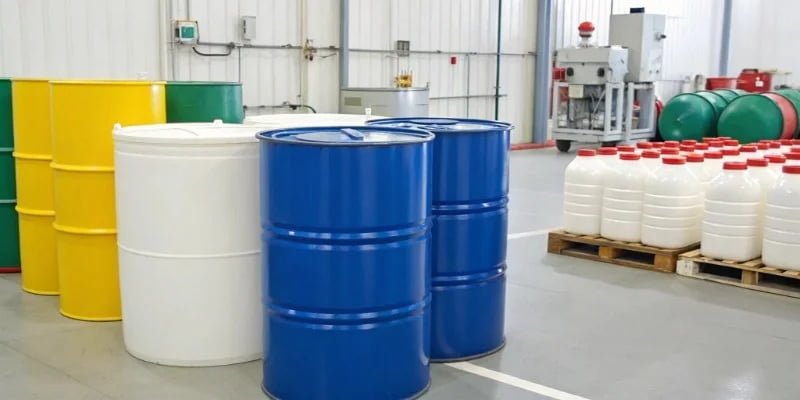
Are you confused by the complex chemistry of polyurethane? It’s easy to get lost in technical data sheets, but you only need to understand the basics to run your line well.
As a manufacturer, you just need to know the two main components: isocyanates (A-side, or "black material") and polyols (B-side, or "white material"). Understanding their basic roles, the ratio you need, and how they react is the key to controlling quality and cost.
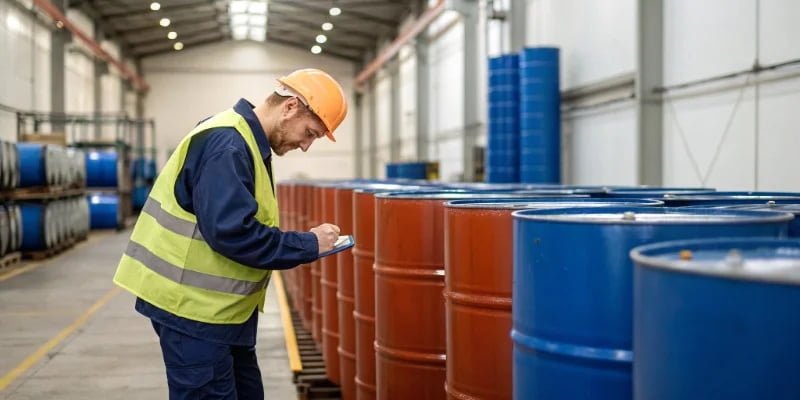
Knowing the two main parts is a great start. But to really control your production and troubleshoot issues, it helps to understand a little more about what these materials are and how they work together. It’s not as complicated as it sounds. We work with production managers like you every day, and we find that a little knowledge goes a long way. Let’s break down the most important questions you might have.
What are the raw materials for polyurethane?
Seeing long lists of chemicals for PU foam can be intimidating. You might think you need a chemistry degree just to order supplies, but it really boils down to two main components.
The main raw materials are Isocyanates (Component A, the "black material") and Polyols (Component B, the "white material"). When mixed, these two liquids react to create polyurethane. Other additives are used in small amounts to create specific properties.
Component A: The "Black Material" (Isocyanate)
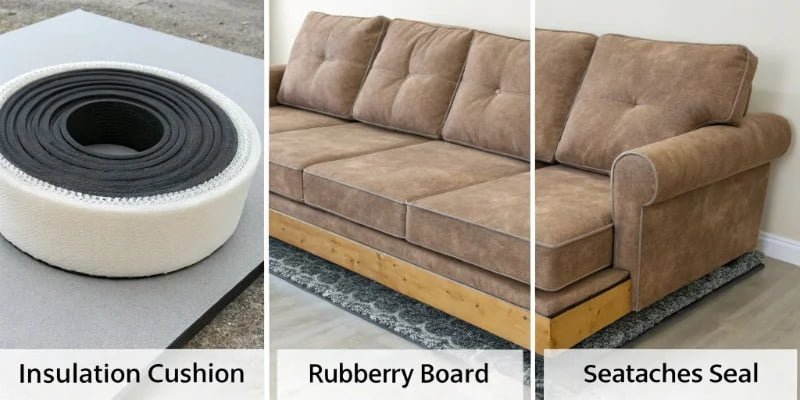
Think of this as the hardener. It’s the component that drives the reaction and gives the final product its strength. For most furniture and insulation applications, you’ll work with Methylene Diphenyl Diisocyanate (MDI)[^1]. For very soft flexible foams, Toluene Diisocyanate (TDI)[^2] is also common. Your job isn’t to know the complex chemistry, but to know which type your product requires. Your raw material supplier will provide this.
Component B: The "White Material" (Polyol Blend)
This is the resin part that forms the body of the foam. But it’s more than just a polyol. Your supplier will deliver this as a pre-made blend that also contains catalysts, blowing agents, and surfactants. We’ll talk more about those later. For you, the important thing is that this blend is designed for your specific product, whether it’s a soft mattress or a hard insulation panel[^3].
| Component | Common Name | Role in the Reaction |
|---|---|---|
| A-Side | "Black Material" | The hardener, provides rigidity and strength |
| B-Side | "White Material" | The resin, forms the foam’s structure and cells |
How is polyurethane manufactured?
Your old machine produces inconsistent foam, wasting a lot of material. Every failed batch costs you money and delays orders. The good news is the manufacturing process is just a simple chemical reaction controlled by your machine.
Polyurethane is made by precisely mixing the Isocyanate (A) and Polyol (B) components in a mixing head. The chemical reaction starts instantly, causing the liquid to expand, rise, and cure into its final foam or elastomer form.
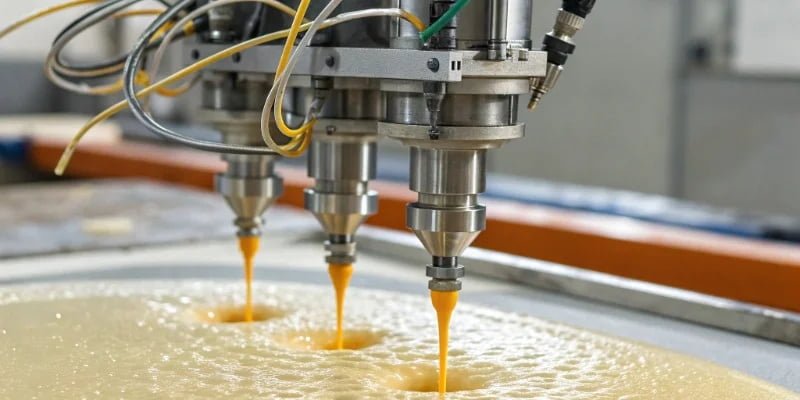
From our experience building hundreds of production lines, the process always comes down to three simple steps. Your machine’s job is to make these steps repeatable and reliable.
Step 1: Metering
This is where quality starts. High-precision pumps on your foaming machine pull the A and B liquids from their tanks and send them to the mixing head. The machine must deliver them at the exact ratio your formulation requires, for example, 100 parts of B to 120 parts of A. Even a small error here can ruin the foam. A modern high-pressure machine maintains a precision of ±0.5%, which drastically reduces waste compared to older equipment.
Step 2: Mixing
The two liquids are forced together under high pressure inside the mixing head. They collide with such force that they mix completely in a fraction of a second. This is called impingement mixing[^4]. It’s extremely efficient and, best of all, the mixing chamber cleans itself after every shot, which means less downtime for cleaning.
Step 3: Dispensing and Curing
The perfectly mixed liquid is then dispensed into a mold or onto a conveyor. You’ll see the reaction happen in real time: it will turn creamy, start to rise, and then harden. These are your cream time, rise time, and tack-free time.
What chemicals are used to make polyurethane?
You look at a supplier’s technical data sheet and see a dozen chemicals you don’t recognize. You start to worry about which ones are important and which are just noise. You only need to focus on the main actors.
The core chemicals are isocyanates and polyols. Besides these, your B-side (polyol) blend contains small amounts of additives: catalysts to control speed, blowing agents to create cells, and surfactants to stabilize the foam structure.
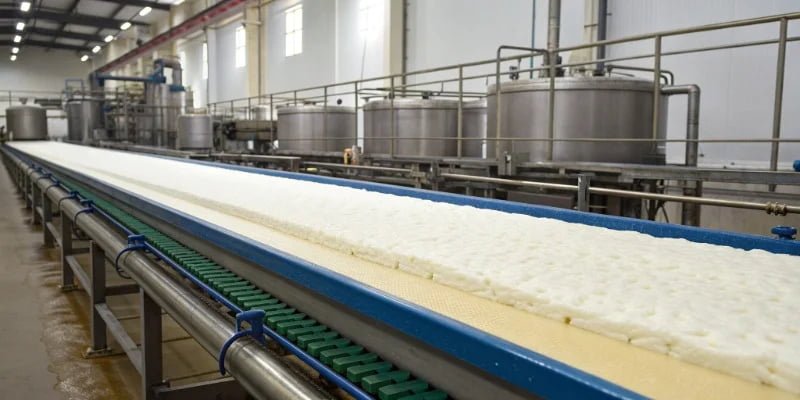
As a production manager, you don’t need to mix these yourself. Your chemical supplier does it for you. But knowing what they do helps you diagnose problems. If your foam is collapsing, you can have an intelligent conversation with your supplier about the surfactant in their blend.
The Drivers: Catalysts
Think of catalysts as the gas pedal for the chemical reaction. They determine how fast or slow the foam forms and cures. If your cure time is too long, it might be a catalyst issue.
The "Air": Blowing Agents
These are what turn the liquid into foam. The blowing agent, often water or a specialized chemical, creates gas bubbles during the reaction. The amount of blowing agent determines the foam’s density. More blowing agent equals lower density foam.
The Stabilizers: Surfactants
Surfactants are like soap. They help ensure the A and B components mix well and they stabilize the bubbles as they form. Without a good surfactant, the foam cells would collapse before the material hardens. If you see poor cell structure, this is often the culprit.
What are the three types of polyurethane?
You know you need polyurethane, but the term is very broad. Choosing the wrong type for your application means the product will fail, and you’ll end up with customer complaints or rejected orders.
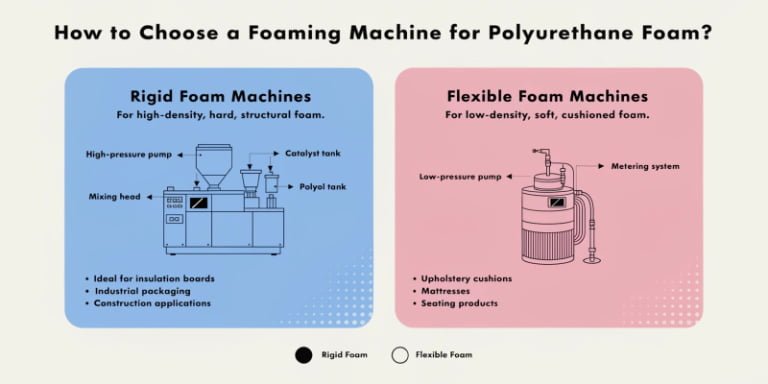
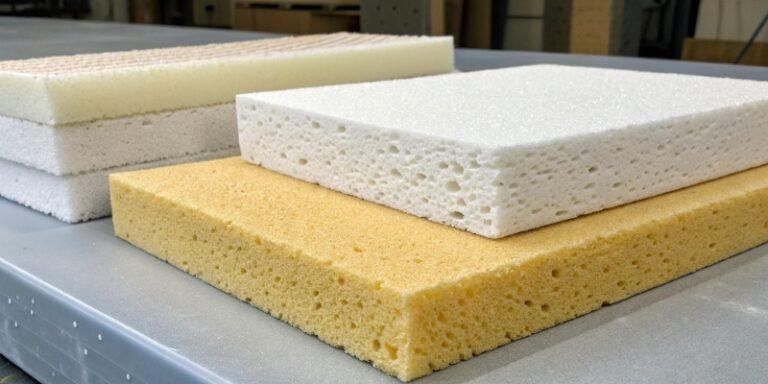
The three main types of polyurethane are flexible foams, rigid foams, and elastomers. Each is made with a different formulation and process, and they are used for completely different products. Your machine should be able to handle the type you need.
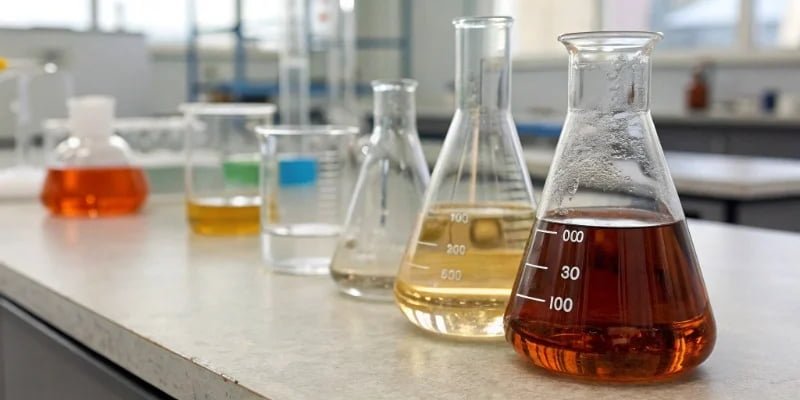
We help customers choose the right machine for their product every day. The main difference comes down to the raw materials and the ratio at which they are mixed. Here is a simple breakdown.
Flexible Foams: For Comfort
These have an open-cell structure[^5], which means they are soft, breathable, and can bounce back after being compressed. This makes them perfect for sofa cushions, car seats, and mattresses. They typically use more of the B-side (polyol).
Rigid Foams: For Structure and Insulation
These have a closed-cell structure[^6] that traps gas, making them excellent insulators. They are also strong and lightweight. You find them in refrigerator walls, insulation panels, and decorative architectural moldings. The A:B ratio is usually much closer to 1:1.
Elastomers: For Durability
These are solid, rubbery, and extremely tough materials. They are not foams. They are used to make things like industrial wheels, high-performance seals and gaskets, and coatings[^7]. The process is often different, sometimes requiring high temperatures.
| Type | Key Property | Common Use | General A:B Ratio Insight |
|---|---|---|---|
| Flexible Foam | Soft, open-cell | Cushions, mattresses | Uses more Polyol (B-Side) |
| Rigid Foam | Hard, closed-cell | Insulation, structural parts | Ratio is often close to 1:1 |
| Elastomer | Solid, rubbery | Seals, wheels, gaskets | Varies, processed as a solid |
Conclusion
You don’t need to be a chemist. Focus on your A and B components, their ratio, and how your machine controls the process. This knowledge helps you solve production problems.
[^1]: "Fabrication and investigation of a novel composite based on …", https://bioresources.cnr.ncsu.edu/resources/fabrication-and-investigation-of-a-novel-composite-based-on-waste-polyurethane-rigid-foam-and-wood-veneer/. This source identifies MDI as a common isocyanate used in polyurethane production, particularly for furniture and insulation applications. Evidence role: general_support; source type: research. Supports: MDI is a commonly used isocyanate in furniture and insulation applications.. Scope note: The source may not cover all applications of MDI in polyurethane production.
[^2]: "Assessment of exposure to TDI and MDI during …", https://ui.adsabs.harvard.edu/abs/2012EnvTP..34..512K/abstract. This source confirms TDI as a widely used isocyanate for producing soft flexible foams in polyurethane manufacturing. Evidence role: general_support; source type: research. Supports: TDI is commonly used for soft flexible foams in polyurethane production.. Scope note: The source may focus on specific types of flexible foams rather than all applications.
[^3]: "one-step synthesis of soybean oil-based polyol for highly …", https://digitalcommons.pittstate.edu/cgi/viewcontent.cgi?article=1463&context=etd. This source discusses how polyol blends are tailored for specific products like mattresses and insulation panels. Evidence role: case_reference; source type: research. Supports: Polyol blends are tailored for specific products like mattresses and insulation panels.. Scope note: The source may not cover all product types that use tailored polyol blends.
[^4]: "Impinging jet mixers: A review of their mixing …", https://web.mit.edu/braatzgroup/Devos_AIChE_2024.pdf. This source describes impingement mixing as a high-pressure method for combining polyurethane components efficiently. Evidence role: mechanism; source type: education. Supports: Impingement mixing is a high-pressure method used to combine polyurethane components efficiently.. Scope note: The source may not address alternative mixing methods for polyurethane.
[^5]: "The Importance of Residential and Commercial Building …", https://extension.okstate.edu/fact-sheets/the-importance-of-residential-and-commercial-building-insulation. This source explains the open-cell structure of flexible polyurethane foams and its role in comfort applications like cushions and mattresses. Evidence role: mechanism; source type: research. Supports: Flexible polyurethane foams have an open-cell structure, making them suitable for comfort applications like cushions and mattresses.. Scope note: The source may not address all comfort applications of open-cell foams.
[^6]: "The Importance of Residential and Commercial Building …", https://extension.okstate.edu/fact-sheets/the-importance-of-residential-and-commercial-building-insulation. This source describes the closed-cell structure of rigid polyurethane foams and its role in insulation and structural applications. Evidence role: mechanism; source type: research. Supports: Rigid polyurethane foams have a closed-cell structure, making them ideal for insulation and structural applications.. Scope note: The source may not cover all applications of closed-cell foams.
[^7]: "APTS Training Course Detail : The University of Akron, Ohio", https://www.uakron.edu/apts/courses/polyurethane-elastomers-chemistry-applications-and-formulations. This source lists industrial wheels, seals, gaskets, and coatings as common applications of polyurethane elastomers. Evidence role: case_reference; source type: research. Supports: Polyurethane elastomers are used in industrial wheels, seals, gaskets, and coatings.. Scope note: The source may not cover all industrial applications of polyurethane elastomers.
Leave a Reply