

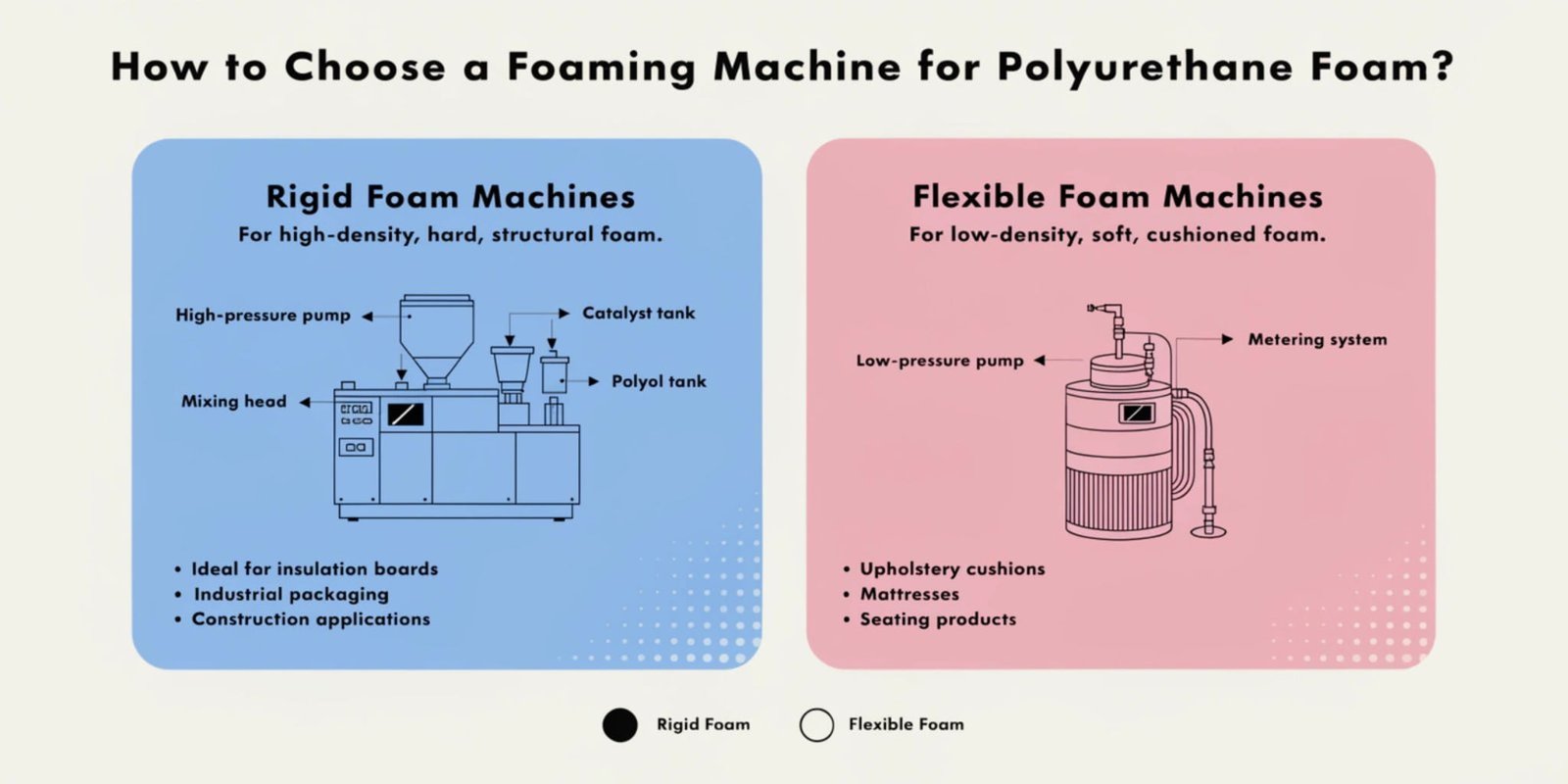
Confused about which foam machine to buy? The wrong choice costs you money and creates production headaches. Let’s break down the options to find the right fit for you.
First, identify your main product: rigid foam for insulation or flexible foam for cushioning. Then, choose your machine. Low-pressure machines are great for rigid foam and are budget-friendly. High-pressure machines offer precision for high-quality flexible foam and reduce waste.
This seems straightforward, but the details are important. Understanding the process for each foam type is the first step. Let’s look at how rigid foam is made. Knowing this will help you see why certain machines are better for certain jobs.
What is the process for making rigid polyurethane foam?
Trying to make rigid foam but worried about the complex process? A mistake can lead to weak, useless products. Let’s simplify the steps so you can produce perfectly.
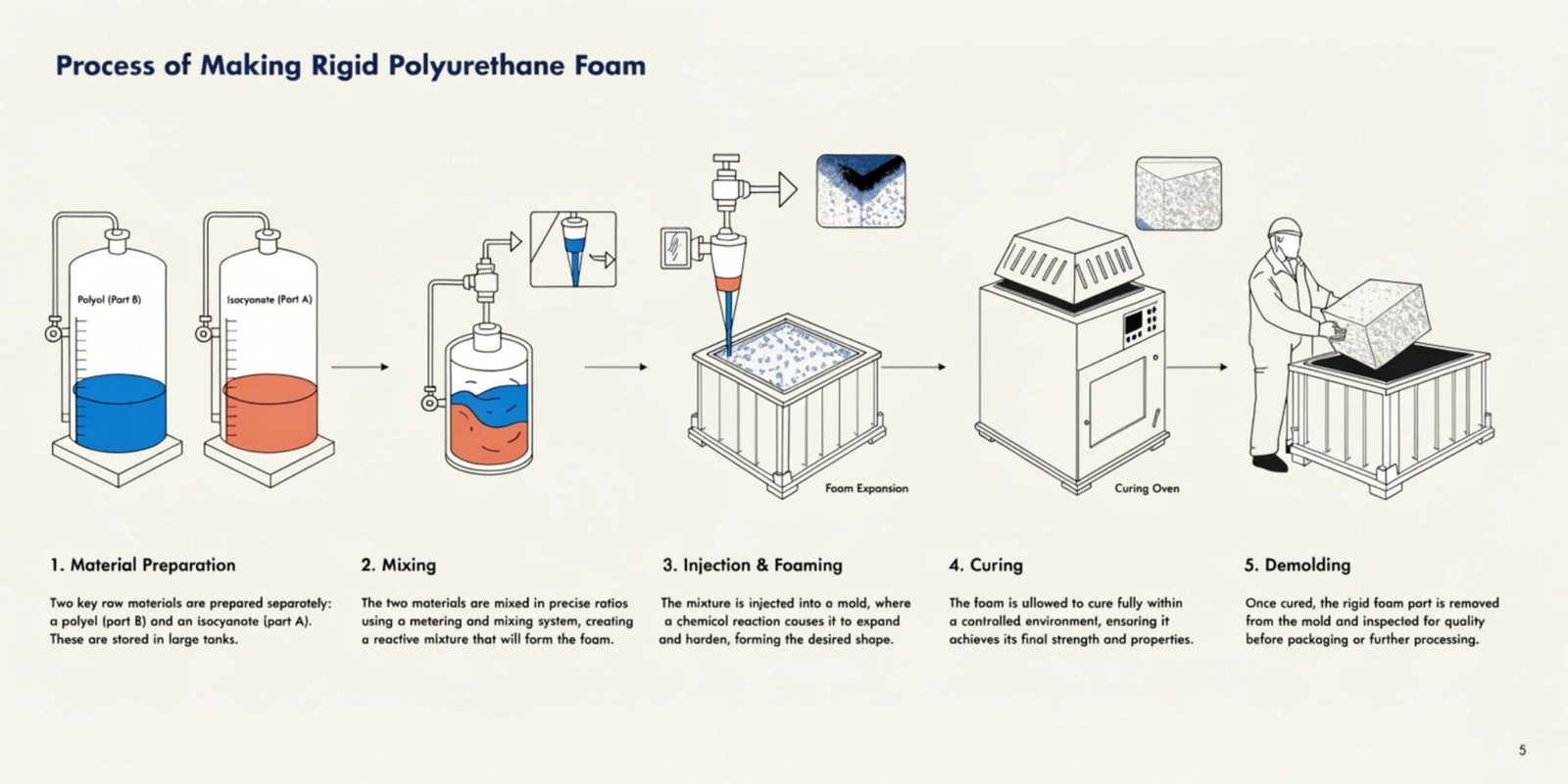
To make rigid foam, you mix two liquids: a polyol blend and an isocyanate. A foaming machine injects and mixes them. The mixture expands inside a mold, creating a lightweight, strong foam perfect for insulation panels, pipes, and packaging applications.
The production of rigid PU foam is a straightforward chemical process that we guide our clients through every day. It’s less demanding than flexible foam production in some ways, which is an important factor when choosing your equipment.
Raw Materials
You start with two main components.
- Component A: Isocyanate (often MDI).
- Component B: A Polyol blend, which also contains catalysts, blowing agents, and surfactants.
Unlike flexible foam, the viscosity of the polyol for rigid foam is typically lower.[^1] This makes it easier to pump and handle, placing less strain on the machine.
The Mixing Stage
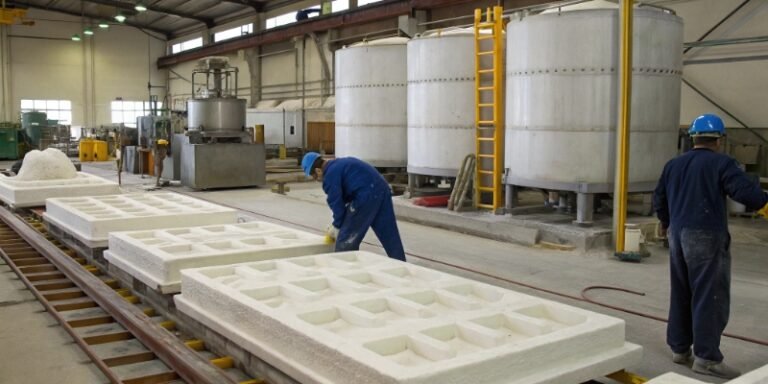
The two components are pumped from their tanks to the mixing head. A low-pressure machine is often sufficient here. It mixes the liquids and injects them into a mold or onto a surface. The precision requirements for the mixing ratio and temperature are less strict for rigid foam compared to high-resilience flexible foam. This makes low-pressure machines a very cost-effective solution.
Curing and Demolding
The chemical reaction starts immediately after mixing. It creates heat and causes the mixture to expand and fill the mold. The foam hardens, or “cures,” very quickly. After just a short time, you can open the mold and remove the finished rigid foam part, ready for the next cycle.
What are the key differences between rigid and flexible PU foam?
Do rigid and flexible foams seem the same to you? Using the wrong one can ruin your product, leading to customer complaints. Let’s highlight the key differences clearly.
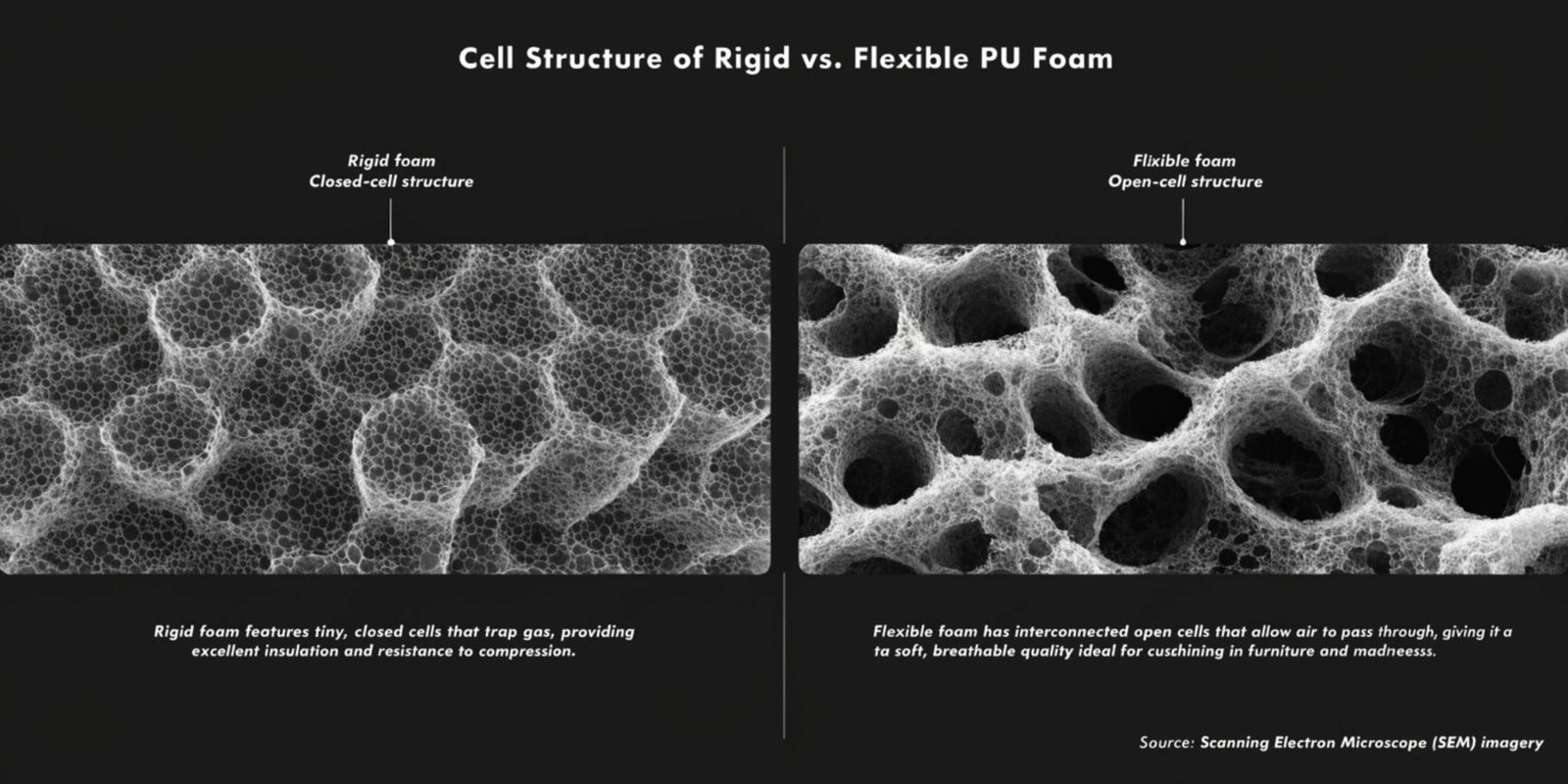
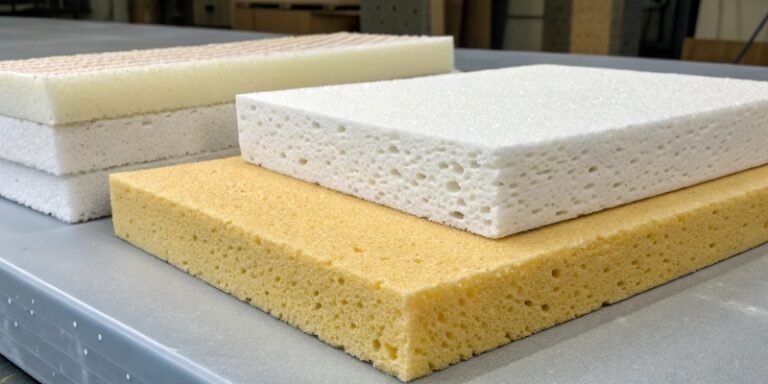
The key difference is their cell structure. Flexible foam has open cells, making it soft and breathable for cushions. Rigid foam has closed cells that trap gas, making it a strong, lightweight insulator for construction and appliances. Their applications are completely different.
Choosing between rigid and flexible foam comes down to your product’s purpose. I’ve worked with many clients like Mr. Hieu in Vietnam, who needed to understand this to justify upgrading his old machine. He was making sofas, so flexible foam was his focus. Let’s break it down further.
Core Structure and Properties
The biggest difference is how the foam is built at a microscopic level. Flexible foam is like a network of connected bubbles, allowing air to pass through. Rigid foam is an array of sealed pockets, trapping gas. This fundamental difference leads to very different uses and requires different production parameters.
Here is a simple table to compare them:
| Property | Flexible Foam | Rigid Foam |
|---|---|---|
| Cell Structure | Open-cell | Closed-cell |
| Feel | Soft, spongy, resilient | Hard, strong, lightweight |
| Primary Use | Cushioning, comfort (furniture, car seats) | Insulation, structural support |
| Airflow | Breathable | Airtight, watertight |
| Key Advantage | Comfort and support | High thermal insulation value |
Understanding this helps you choose the right raw materials and machine settings. For instance, making high-quality flexible foam often requires a high-pressure machine for better mixing and cell consistency. Rigid foam is more forgiving and can be made well with a low-pressure machine.
Which foam is better, PU or HR?
Confused by foam types like PU and HR foam? Picking the wrong one for sofas or mattresses means they’ll sag quickly, hurting your brand. Let’s clarify what’s best.
HR (High Resilience) foam is a premium type of PU foam. It’s more durable, supportive, and comfortable than standard PU foam. For high-use items like sofa cushions or quality mattresses, HR foam is the better choice because it prevents sagging and lasts longer.
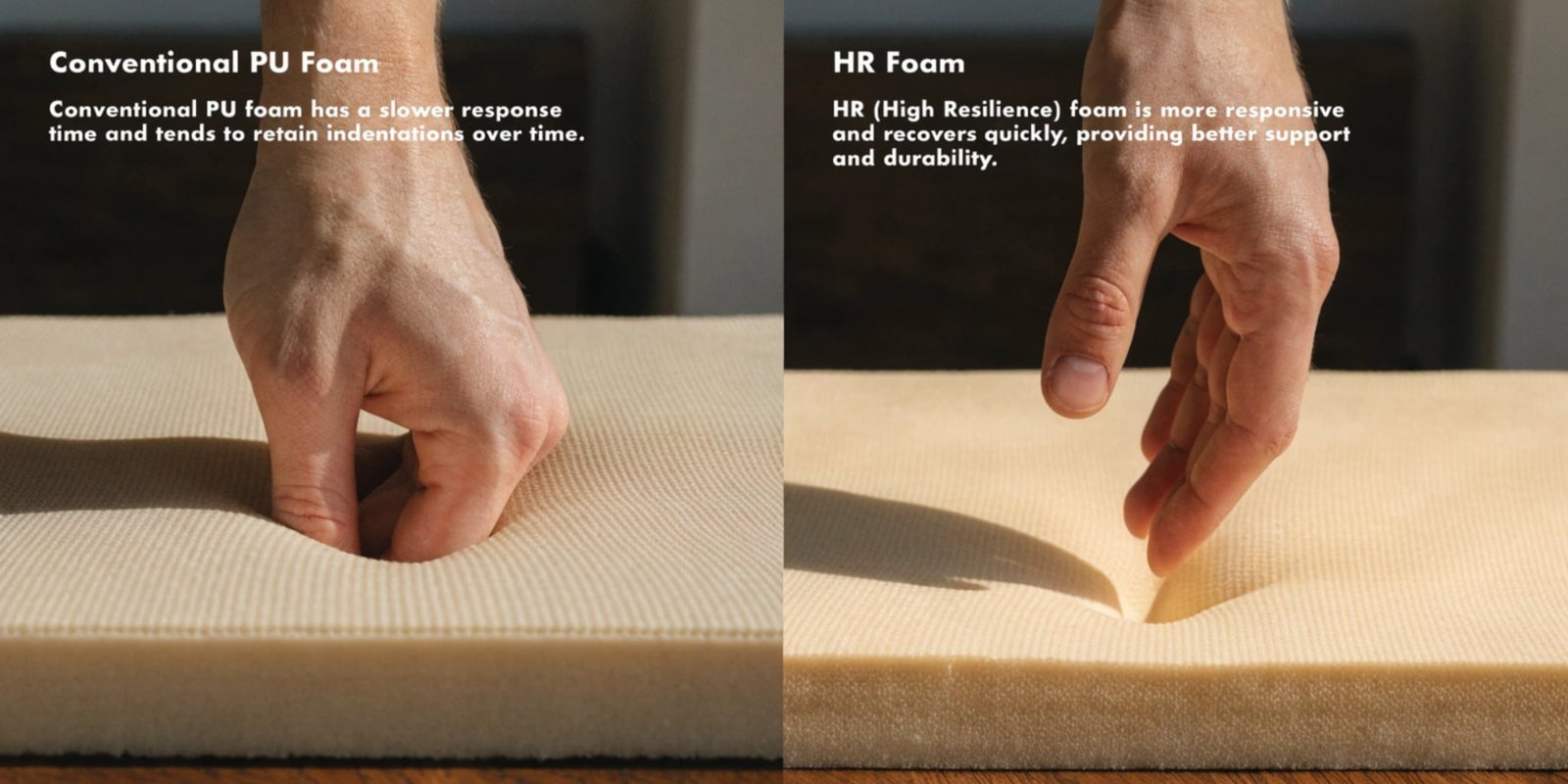
“PU foam” is a general term, while “HR foam” is a specific, high-performance category within it. For furniture makers supplying demanding clients like IKEA, as one of our Vietnamese customers does, this distinction is critical for quality.
Standard PU Foam
This is the conventional foam you find in many basic applications. It provides decent cushioning, but its cell structure is less uniform. Over time, it can lose its shape and support, especially under heavy, repeated use. It’s a cost-effective choice for entry-level products or items that don’t need to withstand a lot of stress.
High Resilience (HR) Foam
HR foam has a different chemical formulation that creates a more random, open-cell structure. This makes it springier and more supportive. It has a higher “support factor,” meaning it feels soft initially but pushes back firmly as you compress it more. This prevents the “bottoming out” feeling common in lower-quality foams. To produce consistent HR foam, a high-pressure machine is almost always necessary for its precise mixing and control.
Cost vs. Performance
HR foam costs more, both in raw materials and the required machinery. However, its superior durability and comfort justify the price for premium furniture. The investment pays off in fewer customer complaints and a stronger brand reputation.
What are the different types of foam machines?
Ready to buy a machine but overwhelmed by the options? A wrong choice can bottleneck your factory and waste your investment. Let’s focus on the two main types available.
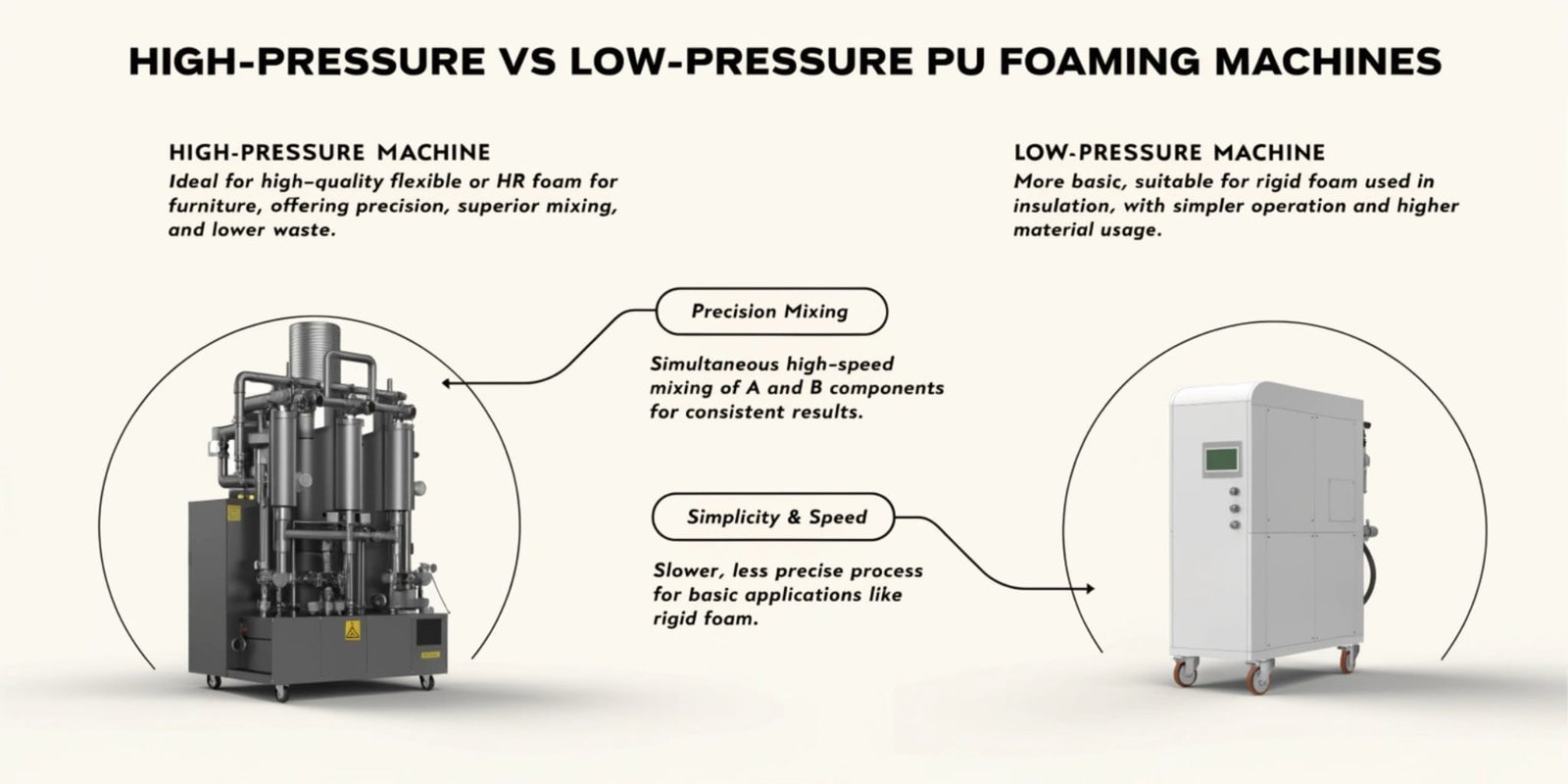
The two main types are low-pressure and high-pressure. Low-pressure machines are affordable and use a mechanical stirrer, great for rigid foam. High-pressure machines use high-speed collision to mix, creating better quality foam with less waste, and are ideal for high-resilience (HR) flexible foam.
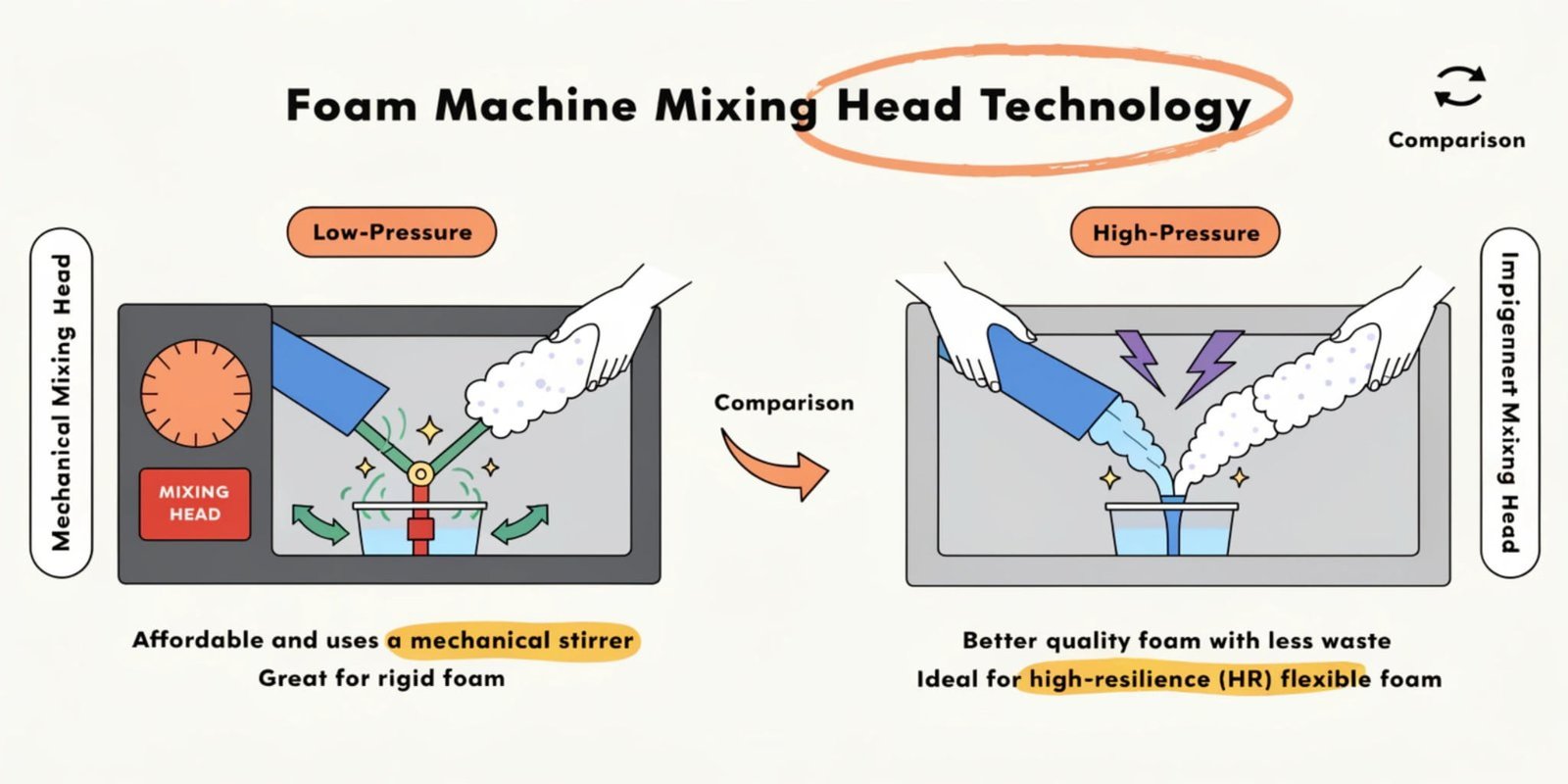
When I talk to production directors like Mr. Hieu, the first question is always about budget versus quality. This is where the choice between a low-pressure and high-pressure machine becomes clear. For nearly 20 years, we’ve helped clients make this exact decision.
The Core Difference: Mixing
The way the machine mixes chemicals is the biggest difference.
- Low-Pressure: Uses a mechanical stirrer, like a blender, in the mixing head. It works, but the mix isn’t perfectly uniform, and it requires solvents for cleaning after each shot, which adds cost and waste.[^2]
- High-Pressure: Pumps chemicals at very high pressure (over 1500 psi), causing them to collide and mix instantly.[^3] This creates a much better, more consistent foam structure. The head is also self-cleaning.
Here’s a comparison:
| Feature | Low-Pressure Machine | High-Pressure Machine |
|---|---|---|
| Mixing Method | Mechanical Stirrer | High-Pressure Impingement |
| Foam Quality | Good, suitable for rigid foam | Excellent, required for HR foam |
| Material Waste | Higher (requires solvent flushing) | Minimal (self-cleaning head)[^4] |
| Initial Cost | Lower | Higher |
| Best For | Rigid insulation, packaging foam | Flexible foam, HR foam, automotive seats |
For a company looking to upgrade quality and reduce raw material costs, like Mr. Hieu’s, investing in a high-pressure machine often has a fast return on investment, sometimes in just 6-12 months from material savings alone.[^5]
Conclusion
Choosing the right machine comes down to your product and goals. High-pressure is best for high-quality flexible foam, while low-pressure is a great, cost-effective choice for rigid foam production.
[^1]: “Natural Oil-Based Rigid Polyurethane Foam Thermal … – PMC”, https://pmc.ncbi.nlm.nih.gov/articles/PMC8707178/. Polyol viscosity depends on molecular architecture, formulation, and measurement temperature, so comparisons between rigid- and flexible-foam systems require matched material data. Evidence role: general_support; source type: paper. Supports: Polyols used for rigid foam typically have lower viscosity than those used for flexible foam.. Scope note: General polyol-property data do not establish that rigid-foam polyols are typically less viscous; the stated direction requires direct comparative evidence.
[^2]: “Flexible Polyurethane Foam Emission Reduction Technologies Cost …”, https://nepis.epa.gov/Exe/ZyPURL.cgi?Dockey=20011YYY.TXT. Solvent flushing of mechanically mixed polyurethane equipment can generate cleaning waste and associated handling costs. Evidence role: mechanism; source type: government. Supports: Low-pressure polyurethane mixing heads require solvent cleaning after every shot, increasing costs and waste.. Scope note: This supports the consequences of solvent flushing where used, not the assertion that every low-pressure head requires it after every shot.
[^3]: “Impinging jet mixers: A review of their mixing …”, https://web.mit.edu/braatzgroup/Devos_AIChE_2024.pdf. High-pressure impingement mixing brings reactive liquid jets into collision, promoting rapid mixing before substantial polyurethane reaction occurs. Evidence role: mechanism; source type: paper. Supports: High-pressure polyurethane machines use pressures above 1,500 psi to mix components through impingement.. Scope note: The mechanism does not establish 1,500 psi as a universal minimum, and rapid mixing is not literally instantaneous.
[^4]: “Manual Best Management Practices for Pollution Prevention in the …”, https://nepis.epa.gov/Exe/ZyPURL.cgi?Dockey=30004QBQ.TXT. Mechanically purged impingement heads can reduce solvent-cleaning waste relative to solvent-flushed systems. Evidence role: mechanism; source type: government. Supports: A self-cleaning high-pressure mixing head results in minimal material waste.. Scope note: Reduced cleaning waste does not establish minimal total material loss, which also includes startup losses, off-ratio shots, and rejected products.
[^5]: “Flexible Polyurethane Foam Emission Reduction …”, https://nepis.epa.gov/Exe/ZyPURL.cgi?Dockey=20011YYY.TXT. A material-savings-only simple payback calculation divides the incremental equipment investment by the annual reduction in material expenditure relative to the baseline process. Evidence role: case_reference; source type: research. Supports: Investment in a high-pressure polyurethane machine can pay back within 6–12 months through material savings alone.. Scope note: A 6–12-month result requires a documented case with explicit costs and savings; a general payback method or waste-reduction study cannot verify that interval.
Leave a Reply