

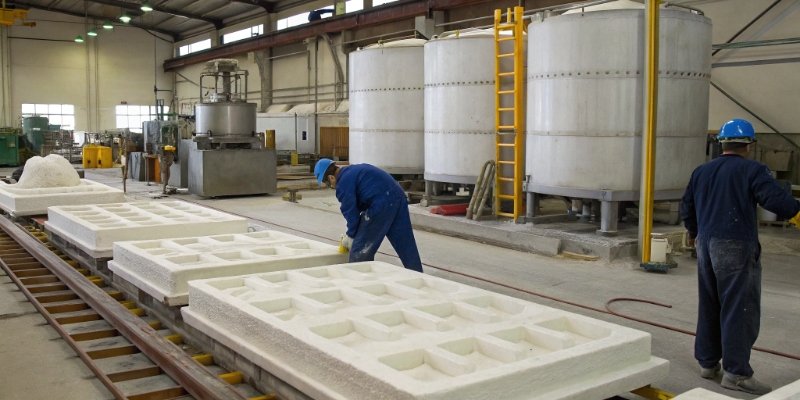
Are you struggling to understand foam production? It can seem like a complex chemical process, but the basic principle is surprisingly simple.
Creating polyurethane (PU) foam involves a chemical reaction between two main liquid components: a polyol blend and an isocyanate. When mixed, they react, expand, and cure to form a solid foam. The final properties depend on the exact chemicals and mixing process used.
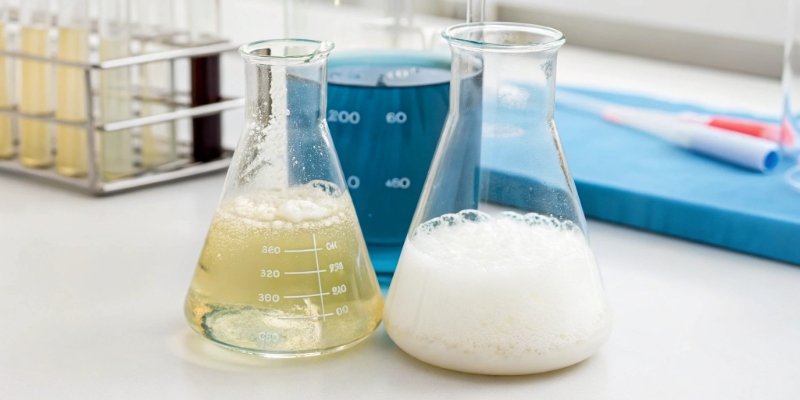
That’s the basic idea, but the real magic is in the details. The difference between a simple spray foam can from the hardware store and a high-quality sofa cushion is huge. It all comes down to the raw materials, the equipment, and process control. We have helped hundreds of factories get this right, and it’s not as difficult as it seems when you have the right partner. Let’s explore how these factors come together to create the perfect foam for your product.
How is PU foam made?
You see foam in furniture, cars, and buildings, but you don’t know the exact process. This makes choosing the right production method feel impossible, but we can break it down.
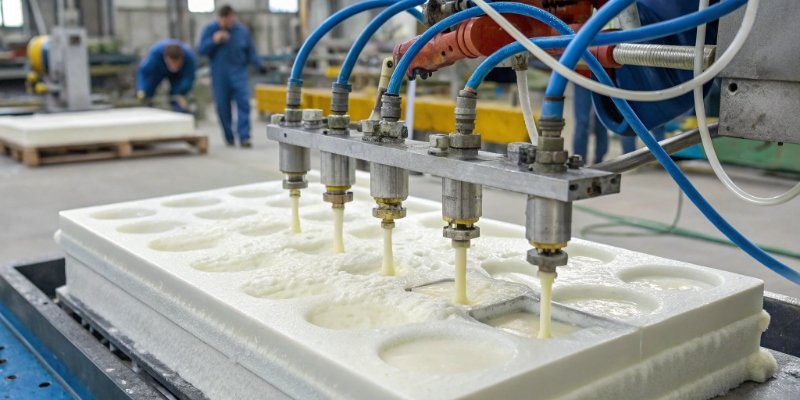
PU foam is made by precisely metering and mixing a polyol blend (Part A) and an isocyanate (Part B) with a machine. The liquid mixture is then dispensed into a mold or onto a surface. The chemical reaction generates heat and CO2 gas, causing it to expand and cure.
The Core Components
At its heart, making PU foam is like a recipe with two main ingredients and a few important spices.
- Part A: The Polyol Blend. This part determines most of the foam’s final properties. It contains the polyol, which dictates if the foam will be soft and flexible or hard and rigid. It also includes catalysts to speed up the reaction, surfactants to control the bubble size, and a blowing agent (often water) that creates the gas for expansion.
- Part B: The Isocyanate. This is the reactive part. When it meets the polyol blend, it starts a process called polymerization, linking all the molecules together to build the foam’s structure.
The Mixing Method
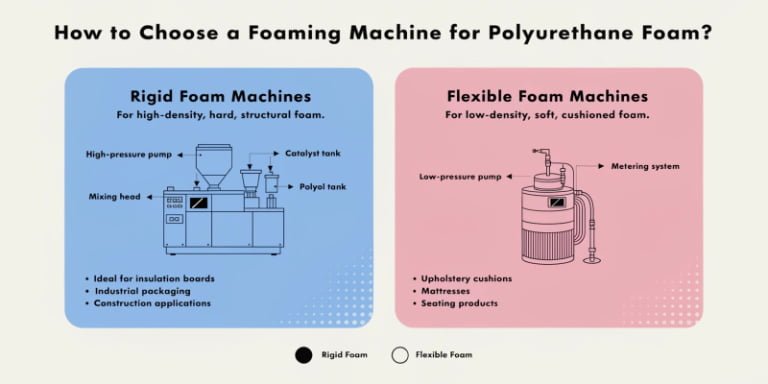
How you mix these two parts is the most critical step for quality. In our industry, we use two main types of machines for this.
| Feature | High-Pressure Machine | Low-Pressure Machine |
|---|---|---|
| Mixing Method | High-speed impingement (liquids collide)[^1] | Mechanical stirrer in a mixing head[^2] |
| Precision | Very high (±0.5% accuracy) | Good, but less precise |
| Material Waste | Minimal due to self-cleaning mixing head | Requires solvent flushing, creating waste |
| Best For | High-Resilience (HR) foam, memory foam, furniture | Rigid insulation foam, packaging foam |
| Investment | Higher initial cost | Lower initial cost |
For a client making high-end sofas for export, a high-pressure machine is necessary. The precision mixing ensures every cushion feels the same, reducing waste and customer complaints. For a company making insulation panels, a low-pressure machine is a very effective and budget-friendly solution.
How do I make homemade foam?
Are you curious about making foam yourself for a small project? You might think you can just buy some chemicals and mix them in a bucket. This is possible for crafts, but it is dangerous and the results are not professional.
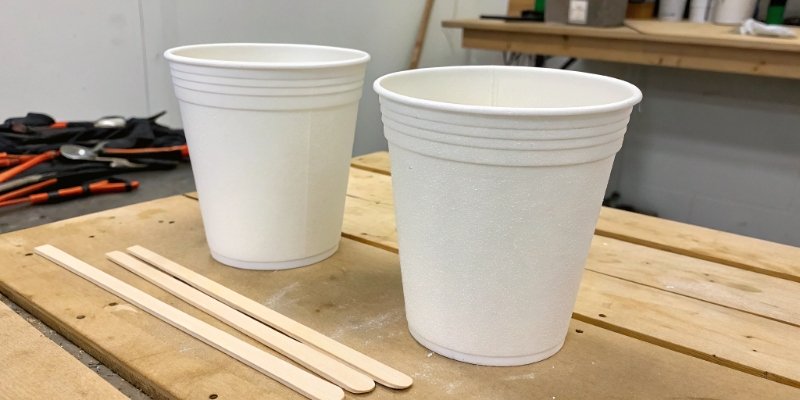
You can make basic rigid foam at home using a two-part “pour foam” kit. You simply measure and mix the two liquids in a disposable cup for about 15-20 seconds and pour it where you need it. However, this is not suitable for any commercial product.
The “DIY” Method Explained
I’ve seen many people try this for small repairs or art projects. These kits come with two bottles, Part A and Part B. You pour equal amounts into a cup, stir very fast with a stick, and then quickly pour it into your cavity or mold. The mixture will start to expand within a minute and becomes hard. It seems easy, but this method has serious limitations if you are thinking about it for a business.
Why This Isn’t for Business
As a professional solution provider, I have to advise against using this method for any real production. Here’s why:
- Safety Risks: Isocyanates (Part B) are serious chemicals. Without proper ventilation and personal protective equipment (PPE) like gloves and respirators, you can develop respiratory problems. The reaction also gets very hot (it’s exothermic) and can cause burns.
- Inconsistent Quality: Mixing by hand is never perfect. You will get hard spots, soft spots, and large, uneven bubbles. You cannot produce a product with consistent density or strength.
- No Control: You get whatever foam the kit is designed to make. You cannot adjust the hardness, density, or reaction time. For industrial products, you need to control these variables to meet customer specifications.
- High Waste & Cost: It’s impossible to be precise when mixing by hand. This leads to wasted material, and these small kits are far more expensive per kilogram than industrial raw materials.
How do you make PE foam?
You may have heard of PE foam and wonder if it’s the same as PU foam. Confusing different foam types is a common mistake that can lead to buying the wrong material or machine for your product. They are completely different.
Polyethylene (PE) foam is made using a physical process, not a chemical one. Plastic PE pellets are melted and mixed with a blowing agent under high pressure. The hot mixture is then pushed through a die, and the pressure release causes it to expand and form a foam structure.
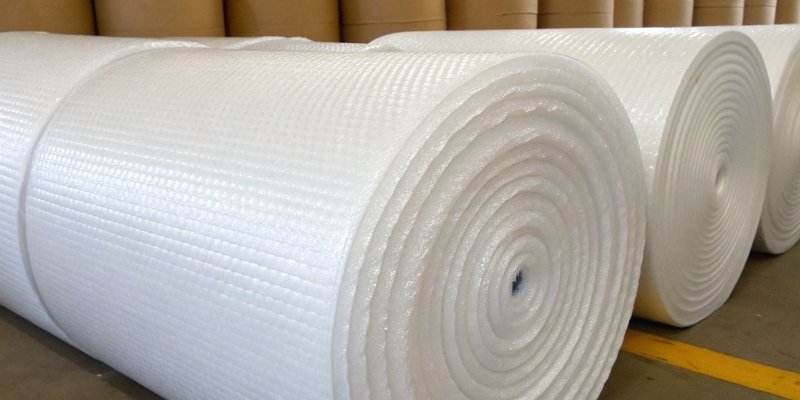
PU Foam vs. PE Foam
I often get questions from clients asking if our machines can make PE foam. The answer is no, because the entire science behind it is different. PU foam is a thermoset plastic; once the chemical reaction happens, it cannot be melted or reshaped. PE foam is a thermoplastic; you can melt it down and reform it.[^3] This fundamental difference leads to very different manufacturing processes and applications. To make it clear for production managers and engineers, I always use a simple table to explain.
| Feature | Polyurethane (PU) Foam | Polyethylene (PE) Foam |
|---|---|---|
| Chemical Type | Thermoset (chemically cured) | Thermoplastic (melted and formed) |
| Manufacturing | Liquid chemical reaction in a machine | Plastic extrusion with a blowing agent |
| Structure | Open-cell (like a sponge) or closed-cell | Always closed-cell (non-absorbent) |
| Feel | Soft and cushioning or hard and structural | Firm, lightweight, and slightly waxy |
| Common Uses | Sofa cushions, car seats, mattresses, insulation panels | Packaging, flotation devices, gym mats, pipe insulation |
If your business is making furniture, automotive interiors, or building insulation, you need a PU foam solution. If you are in the protective packaging industry, you are likely looking for PE foam. Understanding this difference is the first step to finding the right supplier.
Is PU foam hard?
You know you need foam, but you’re not sure if it has the right hardness for your product. Choosing the wrong foam can lead to product failure and unhappy customers. The great news is that PU foam can be whatever you need it to be.
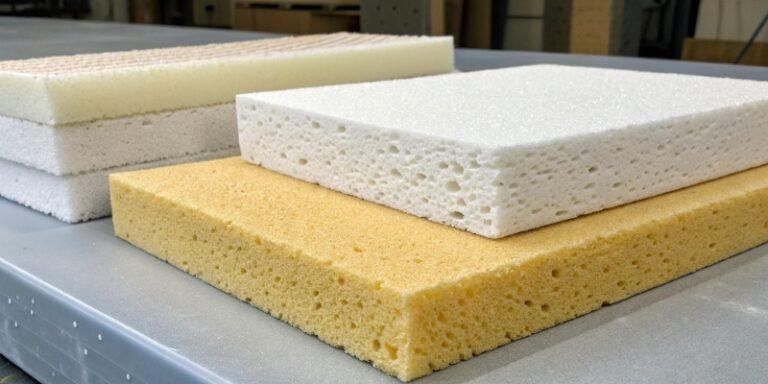
PU foam is incredibly versatile. It can be made extremely soft and flexible, like in a memory foam pillow, or very hard and rigid, like in structural insulation panels. The hardness is controlled by the specific polyol chemicals and additives used in the formulation.
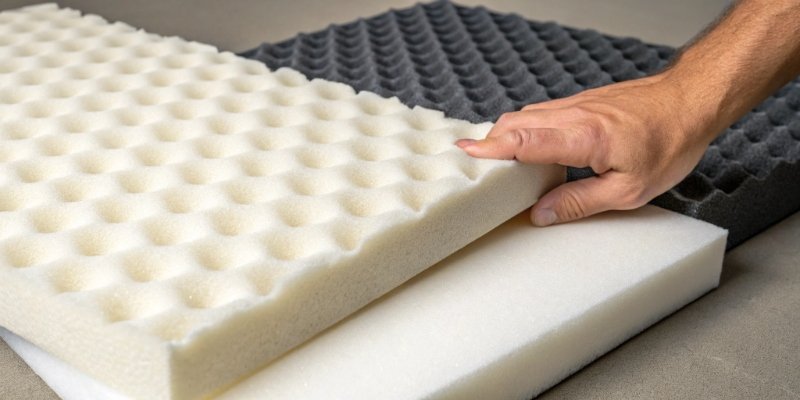
The Spectrum of PU Foam
One of the best things about polyurethane is the massive range of properties we can achieve. It’s not one single material. In my nearly 20 years in this industry, I have helped clients create foam for countless applications. The hardness is directly related to the foam’s internal structure.
- Flexible Foam: This type has an open-cell structure, which means the small bubbles inside the foam are interconnected. This allows air to pass through, making it breathable and soft. We use this for comfort products like mattresses (memory foam, HR foam) and furniture cushions.
- Rigid Foam: This type has a closed-cell structure. The bubbles are not connected, which makes the foam very strong and an excellent insulator for heat and sound. We use this for refrigerator walls, insulation boards, and decorative wood-imitation beams.
- Semi-Rigid & Integral Skin Foam[^4]: This is a special category where we create a product with a dense, tough outer skin and a softer foam core, all in one shot. Think of car steering wheels, armrests, and office chair components.
How We Control Hardness
Achieving the right hardness is not guesswork. It’s a science. The formulation is a trade secret for many companies, but the principles are well-known.
- The Polyol: This is the main controller. We use long, flexible polyol molecules to create soft foams and short, complex polyol molecules to create hard, rigid foams.
- The Isocyanate Index: Adjusting the ratio of isocyanate to polyol changes the amount of chemical cross-linking in the foam structure.[^5] More cross-linking generally leads to a harder, more rigid foam.
- Additives: We can also use fillers, like calcium carbonate, to increase the density and hardness of the foam while sometimes reducing cost.
As a solutions provider, our job is not just to sell you a machine. It’s to give you the process support and starting formulations to make the exact foam your product requires.
Conclusion
Creating the right PU foam requires the correct chemicals, a precise process, and reliable equipment. We help you master all three for your specific production needs.
[^1]: “The Effect of Mixing Pressure in a High-Pressure Machine …”, https://www.academia.edu/97931254/The_Effect_of_Mixing_Pressure_in_a_High_Pressure_Machine_on_Morphological_and_Physical_Properties_of_Free_Rising_Rigid_Polyurethane_Foams_A_Case_Study. This source explains high-speed impingement mixing, where liquids collide to ensure uniform blending in PU foam production. Evidence role: mechanism; source type: research. Supports: High-speed impingement mixing involves liquids colliding to achieve uniform blending in PU foam production..
[^2]: “Cork liquefaction for polyurethane foam production”, https://bioresources.cnr.ncsu.edu/resources/cork-liquefaction-for-polyurethane-foam-production/. This source describes the use of mechanical stirrers in low-pressure machines for PU foam production. Evidence role: mechanism; source type: research. Supports: Mechanical stirrers are used in low-pressure machines to mix PU foam components..
[^3]: “Thermoplastics Foams: An Automotive Perspective”, https://open.clemson.edu/cgi/viewcontent.cgi?article=1105&context=auto_eng_pub. This source explains that PE foam is a thermoplastic, allowing it to be melted and reshaped. Evidence role: definition; source type: encyclopedia. Supports: PE foam is classified as a thermoplastic, which can be melted and reshaped..
[^4]: “Bio-based rigid polyurethane foam prepared from apricot …”, https://bioresources.cnr.ncsu.edu/resources/bio-based-rigid-polyurethane-foam-prepared-from-apricot-stone-shell-based-polyol-for-thermal-insulation-application-part-2-morphological-mechanical-and-thermal-properties/. This source explains the properties and applications of semi-rigid and integral skin foam, including its dense outer skin and softer core. Evidence role: definition; source type: encyclopedia. Supports: Semi-rigid and integral skin foam has a dense outer skin and a softer core, suitable for applications like steering wheels and armrests..
[^5]: “Effect of ingredient ratios of rigid polyurethane foam on …”, https://www.academia.edu/102281555/Effect_of_ingredient_ratios_of_rigid_polyurethane_foam_on_foam_core_panels_properties. This source discusses how the isocyanate-to-polyol ratio affects chemical cross-linking and foam properties. Evidence role: mechanism; source type: research. Supports: The isocyanate-to-polyol ratio directly impacts the chemical cross-linking and properties of PU foam..

Leave a Reply