

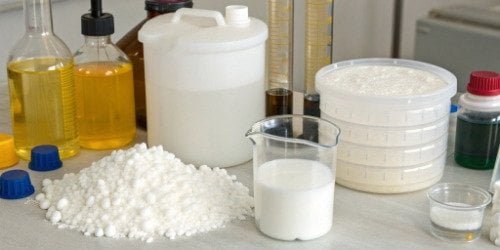
Struggling with complex chemical names for foam? You worry about choosing the wrong materials, but it’s simpler than you think. You only need to know two main components.
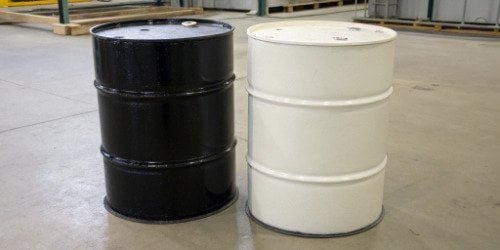
PU foam is made by mixing two main liquid components: Isocyanate (often called Component A or “black material”) and a Polyol blend (Component B or “white material”). Your foaming machine precisely mixes these two liquids, which then react and expand to create the final foam product.
This two-part system is the foundation of all polyurethane foam production. I’ve seen many factory owners like you feel overwhelmed by chemistry. But you don’t need to be a scientist to make great foam. Your focus should be on getting the right pre-made system for your product and letting the machine handle the precise mixing. Understanding this basic A+B concept is the first step. Let’s break it down further so you can speak confidently with suppliers and your own team.
What is PU foam made of?
The long list of chemicals can be overwhelming. You might feel lost trying to understand what’s really inside your foam. The truth is, it all comes down to two main parts.
PU foam is made from Isocyanate (Component A) and a Polyol blend (Component B). This Polyol blend also contains crucial additives like catalysts, blowing agents, and surfactants that control how the foam forms and what properties it will have, like softness or rigidity.
When we work with clients, we simplify the raw materials into two groups. This makes it much easier to manage on the factory floor. You don’t need to worry about mixing tiny amounts of ten different chemicals. The chemical supplier does that for you.
The Two-Component System
Think of it as a kit. You get one can of “black material” and one can of “white material”.
- Component A (The “Black” Material): This is the Isocyanate. Its job is to provide strength and structure. It’s the backbone of the foam. The most common types for furniture or insulation are MDI and TDI.[^1]
- Component B (The “White” Material): This is the Polyol blend. This part determines if the foam is soft and flexible, or hard and rigid. It also contains all the important additives that make the reaction happen correctly.
Here is a simple table to help you remember:
| Component | Common Name | Main Chemical(s) | Role in the Foam Reaction |
|---|---|---|---|
| A-Side | Black Material | Isocyanate (MDI/TDI) | Acts as the hardener, creates the foam’s core structure and strength. |
| B-Side | White Material | Polyol & Additives | Determines flexibility, density, and cell structure. Contains catalysts, blowing agents, and stabilizers. |
So, when you order materials, you are ordering a perfectly matched A+B system.
What is the raw material for making foam?
You need to order materials for your factory. But you’re not sure what exact chemical names to ask for from your supplier. Don’t worry, you just need to know two simple terms.
The raw materials you order for making foam are sold as a two-part system: “Component A” (Isocyanate) and “Component B” (a pre-mixed Polyol blend). You simply tell the supplier what product you are making, for example, “sofa cushions” or “insulation panels”.
I remember talking to Mr. Hieu, a production director in Vietnam. He was worried because he didn’t have a deep background in chemistry. He knew his old machine was wasting materials, but he didn’t know what to order to improve quality. I told him his job is not to be a chemist; it’s to be a production expert.
How to Order Your Raw Materials
You don’t need to give your supplier a long list of chemicals. Instead, you describe your final product and its requirements.
For example, you would contact a chemical supplier and say:
“I need a foam system to produce high-resilience flexible foam for sofa cushions. The density should be around 35 kg/m³.[^2]”
The supplier will then provide you with a matched system:
- A specific Isocyanate (A-Side) that works for that application.
- A custom Polyol blend (B-Side) that is already formulated with the right additives to achieve the density, softness, and reaction time you need.
The B-Side is pre-mixed by the chemical company.[^3] This takes all the guesswork out of your hands. At Foamor, we don’t sell chemicals, but we have nearly 20 years of experience. We always help our clients connect with reliable raw material suppliers and ensure the formula works with our machines.
How do you make PU foam?
You have the two liquids, Component A and Component B. But how do they magically turn into a solid foam cushion? It’s a simple, controlled mixing process managed by a machine.
You make PU foam by using a foaming machine to pump, meter, and mix Component A and Component B at a precise ratio. The machine injects the perfect mixture into a mold, where a fast chemical reaction causes it to expand and cure into solid foam.
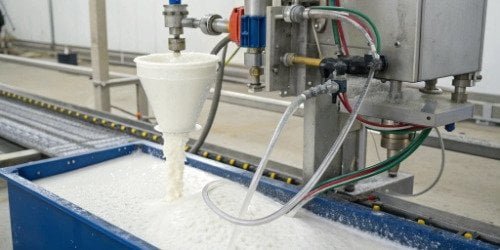
Our machines, whether they are high-pressure or low-pressure models, are designed to make this process foolproof and efficient. The entire transformation from liquid to solid happens in just a few minutes. Here’s a look at what the machine does.
The Foaming Process in 3 Steps
- Metering: The machine has two separate tanks, one for the A-Side liquid and one for the B-Side. High-precision pumps draw the liquids and control the flow rate very accurately. Getting this ratio right is the key to consistent foam quality. For example, the ratio might be 100 parts of Polyol to 45 parts of Isocyanate.
- Mixing: The two liquids are then injected into a small mixing head. In our high-pressure machines, they collide at very high speeds. This creates an extremely thorough mix in less than a second. This ensures every drop of A meets every drop of B.
- Expanding and Curing: The liquid mixture is immediately dispensed from the mixing head’s nozzle into a mold. A chemical reaction starts instantly. It generates heat and gas, which causes the liquid to bubble and expand, filling the entire mold.[^4] After a few minutes, the reaction is finished, and the foam becomes a solid part that you can remove.
Is PU foam solid?
You see two liquids go into a mold. A few minutes later, you pull out a foam block that feels solid. It can be confusing. Is it really a solid material?
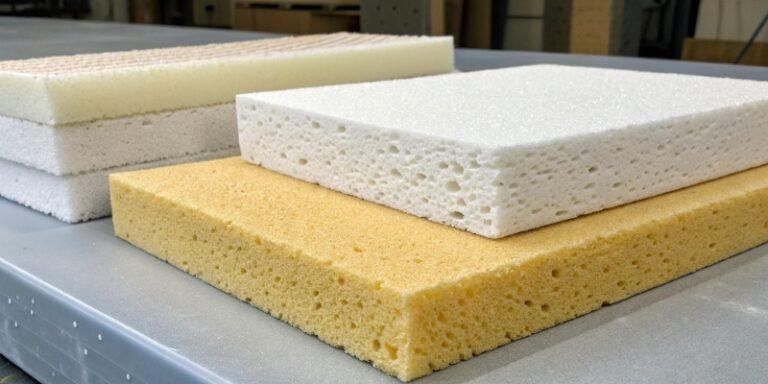
Yes, PU foam is a solid. It begins as two liquids, but a chemical reaction called polymerization quickly transforms them into a stable, solid cellular structure. The final product can be very soft or very hard, but it is always in a solid state.
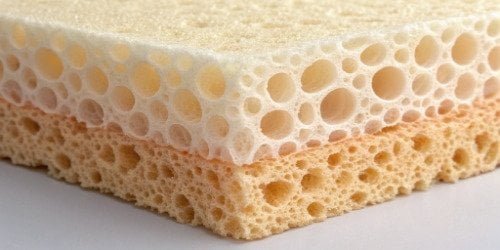
It’s helpful to think of PU foam not as a simple solid like a piece of plastic, but as a “cellular solid”. It’s a solid material that is full of tiny bubbles, or “cells”. Imagine a loaf of bread. It is solid, but full of air pockets. PU foam is similar, but the structure is much more controlled.
The Difference in Solid Structures
- Open-Cell Structure: This is found in flexible foams, like those used for mattresses and furniture. The tiny cells inside the foam are not fully sealed; they are connected to each other. This allows air to pass through, which makes the foam feel soft, breathable, and able to bounce back after you press it.
- Closed-Cell Structure: This is found in rigid foams, such as those used for building insulation or refrigerator walls. Here, the cells are completely sealed off from each other. This traps gas inside, which gives the foam amazing insulation properties. It also makes the foam very strong, light, and unable to absorb water.
So, whether it’s soft enough to sleep on or strong enough to support a wall, the polyurethane foam you produce is definitely a solid material.
Conclusion
PU foam raw materials are simple. It’s just Component A and Component B. A good machine does the hard work of mixing them perfectly to create your final solid foam product.
[^1]: “Assessment of exposure to TDI and MDI during …”, https://ui.adsabs.harvard.edu/abs/2012EnvTP..34..512K/abstract. This source discusses the common types of Isocyanates used in polyurethane foam production, including MDI and TDI. Evidence role: general_support; source type: education. Supports: MDI and TDI are the most common types of Isocyanates used for furniture and insulation foam..
[^2]: “Performances of green velvet material (PLON) used in …”, https://bioresources.cnr.ncsu.edu/resources/performances-of-green-velvet-material-plon-used-in-upholstered-furniture/. This source provides standard density ranges for high-resilience flexible polyurethane foam used in furniture applications. Evidence role: statistic; source type: education. Supports: High-resilience flexible polyurethane foam for furniture typically has a density of around 35 kg/m³.. Scope note: Density ranges may vary based on regional standards or specific formulations.
[^3]: “Soy-based polyurethane foam for insulation and structural …”, https://scholarsmine.mst.edu/cgi/viewcontent.cgi?article=3890&context=doctoral_dissertations. This source explains the pre-mixing process of Polyol blends by chemical suppliers for polyurethane foam production. Evidence role: mechanism; source type: education. Supports: Polyol blends (B-Side) are pre-mixed by chemical companies for ease of use in PU foam production..
[^4]: “Science Kit for Student Use: Polyurethane Foam”, http://www.csun.edu/scied/2-chem/sckit/sckit.htm. This source describes the chemical reaction in polyurethane foam production, including heat and gas generation. Evidence role: mechanism; source type: education. Supports: The chemical reaction in PU foam production generates heat and gas, causing the liquid to expand and fill the mold..
[^5]: “CHICKEN FAT-BASED POLYURETHANE – Digital Commons”, https://digitalcommons.pittstate.edu/cgi/viewcontent.cgi?article. This source discusses how raw materials and cell structure influence the properties of polyurethane foam. Evidence role: mechanism; source type: education. Supports: The properties of solid PU foam are influenced by the raw materials and cellular structure..
Leave a Reply