

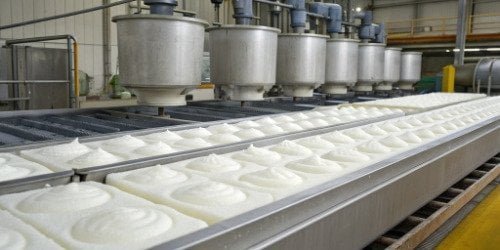
Trying to make 37 density foam but getting inconsistent results? This wastes raw materials and hurts your quality. We’ll show you the right way to achieve it.
To make PU foam with a 37 kg/m³ density, you need to carefully control the formulation and the foaming process. This is typically achieved by injecting a precise mix of polyol and isocyanate into a closed mold. The restricted space limits expansion, creating a denser, more rigid structure.
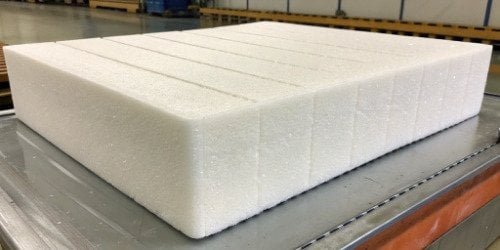
This specific density is common for insulation and structural applications. But to really understand how to control it, we need to go back to the basics. It all starts with understanding how PU foam is made in the first place and what “density” really means for your product. Let’s break it down further.
How is PU foam made?
Curious about making polyurethane foam but the chemistry seems complicated? Mixing chemicals incorrectly leads to poor quality foam. It’s simpler than you think: it all starts with two liquids.
PU foam is created by a chemical reaction between two main components: a polyol and an isocyanate. When mixed, they expand rapidly to form a cellular structure. Additives like catalysts, blowing agents, and surfactants are used to control the reaction speed, density, and cell structure.
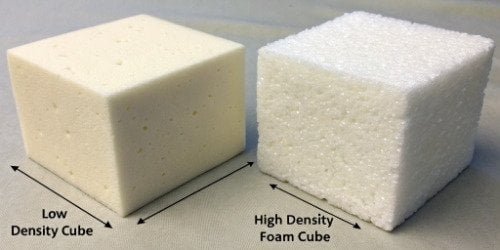
Making PU foam is a bit like baking a cake. You need the right ingredients, the right mix, and the right “oven” or mold. The process always involves two primary liquids that we keep in separate tanks on our machines.
The Core Ingredients
The magic happens when Polyol and Isocyanate are mixed. Think of them as the flour and water of our cake. But to get the perfect foam, we need other ingredients too.
Key Additives and Their Roles
| Additive | Purpose | What it Does for Your Foam |
|---|---|---|
| Blowing Agent | Creates the bubbles | Determines the foam’s density. Water is a common blowing agent. |
| Catalyst | Controls reaction speed | Decides how fast the foam rises and cures (hardens). |
| Surfactant | Stabilizes the bubbles | Ensures the foam cells are uniform and don’t collapse. |
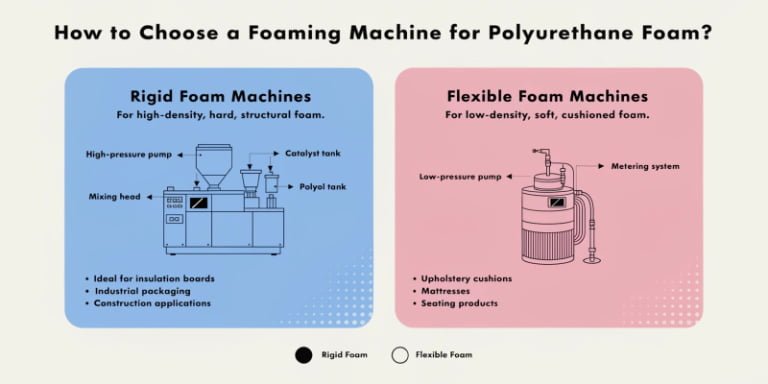
Our foaming machines, whether high-pressure or low-pressure, are designed to mix these components with extreme precision. The mixing head then dispenses the liquid mixture into a mold or onto a surface, where it expands and solidifies into the final foam product. It’s a precise science, but with the right equipment, it becomes a reliable production process.
What is the density of PU foam?
Confused by what “foam density” means for your product? Choosing the wrong one leads to failures and customer complaints. It’s simply a measure of weight per volume.
Foam density is a measurement of how much a foam weighs per unit of volume, typically expressed in kilograms per cubic meter (kg/m³). It is a key indicator of the foam’s quality, durability, support, and cost.

Density is one of the most important properties of PU foam[^1]. It tells you how much “stuff” is packed into a certain space. A higher density foam has more material and less air in the same volume[^2], which directly affects its performance and price.
Why Density Matters
A higher density doesn’t always mean a harder foam[^3], but it almost always means a more durable and supportive one. For a business owner, this is critical. Using a higher density foam for a sofa cushion means it will last longer and provide better support[^4], justifying a higher price. Using a low-density foam for a simple packaging application saves you money on materials.
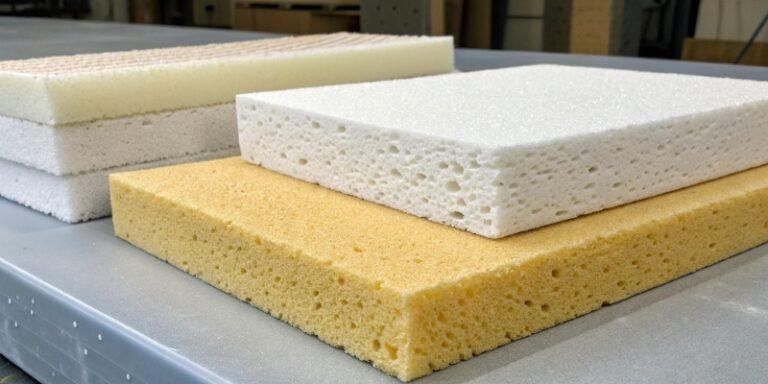
Common PU Foam Densities and Their Uses
| Application | Typical Density Range (kg/m³) | Key Characteristic |
|---|---|---|
| Free-Rise/Natural Foam | 20-30 | Very light, soft, low cost |
| Insulation Filling | 35-45 | Good thermal resistance, structural |
| Furniture Cushions | 25-50 | Balance of comfort and support |
| Automotive Seats | 100-200 | High durability, self-skinning |
| Steering Wheels | 400-500 | Extremely dense, solid feel |
As you can see, the 37 kg/m³ density you asked about falls right into the insulation and structural filling category. Choosing the correct density is the first step to making a quality product.
How is high-density foam made?
Want to produce stronger, more durable foam for high-end products? Just pouring more chemicals won’t work and is wasteful. The key is to control the foam’s expansion.
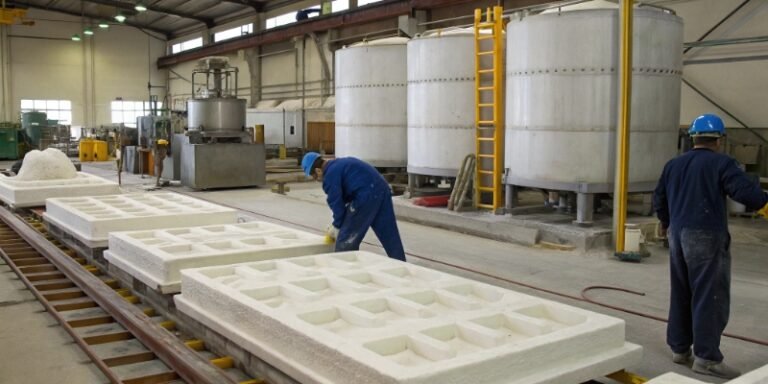
High-density foam is made by restricting the foam’s expansion during the chemical reaction. This is done by injecting a precise amount of the chemical mixture into a closed mold that is smaller than the volume the foam would occupy if it were allowed to expand freely.
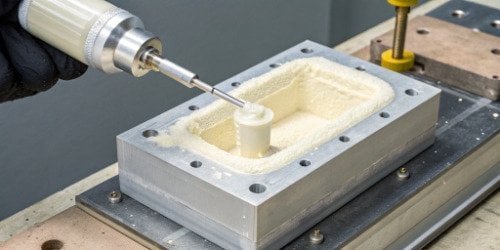
Making high-density foam is all about working against the foam’s natural tendency to expand. We call this “over-packing” or “molding with a higher pack factor.”
The Concept of Over-Packing
Imagine your foam’s free-rise density is 25 kg/m³. This means if you pour it into an open box, this is the density you will get. To make foam with a density of 50 kg/m³, you need to force the same amount of chemical into a mold that is half the size[^5]. This increases the density. The mold physically stops the foam from expanding further, compressing the cell structure and making it denser[^6].
Key Factors for High-Density Production
| Factor | Why It’s Important | Our Solution |
|---|---|---|
| Mold Strength | Higher density means higher expansion pressure inside the mold. | We help design robust molds that can withstand the pressure without deforming. |
| Machine Precision | You must inject the exact amount of material every time. | Our high-pressure machines offer precision metering (±0.5%) for consistent results. |
| Clamping Force | The mold must be held shut securely against the expansion force. | We integrate our machines with proper clamping presses for your production line. |
For products like automotive seats or high-quality furniture, achieving a consistent high density is non-negotiable. It requires a system where the machine, the mold, and the process work together perfectly. That’s the kind of turnkey solution we specialize in providing.
Is 40 density foam hard or soft?
Think a 40 density foam is automatically hard? This common mistake can lead you to create uncomfortable products. Density and hardness are separate properties that you can control.
A 40 kg/m³ density foam is not inherently hard or soft. Hardness is controlled by the foam’s chemical formulation, specifically the type of polyol used. Density relates to durability and support. You can have a soft, high-density foam or a firm, low-density foam.
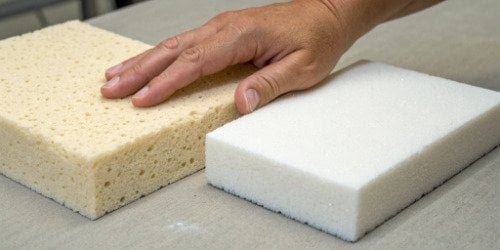
This is a question I get all the time from production directors. It’s a critical point to understand. Density does not equal hardness.
Density vs. Hardness
- Density (kg/m³): This is about weight and durability. It tells you how long the foam will last under use. A 40 density foam has more “foam material” in it than a 25 density foam, so it will resist breaking down for longer.
- Hardness (ILD): This is about comfort and feel. It measures the force needed to compress the foam. This is controlled by changing the chemical ingredients in your formula, not by changing the density.
How to Get the Foam You Need
Let’s say you’re making a premium sofa cushion.
- You want it to be durable and supportive, so you choose a higher density, like 40 kg/m³.
- You also want it to be soft and comfortable to sit on, so you tell us to adjust the formulation to achieve a low ILD (hardness) value.
With our process and formulation support, you can achieve both. We help you select the right chemicals and machine settings to produce a foam that is both durable and comfortable. You don’t have to choose one or the other.
Conclusion
Making 37 density foam requires precise control over your formula and process. Understanding density, hardness, and the right equipment is key to producing high-quality, consistent PU foam products.
[^1]: “Effect of foam density on the properties of water blown rigid …”, https://www.academia.edu/64878977/Effect_of_foam_density_on_the_properties_of_water_blown_rigid_polyurethane_foam. This source discusses the importance of density in determining PU foam’s quality and applications, supporting the claim about its significance. Evidence role: expert_consensus; source type: research. Supports: Density is a critical property for determining PU foam’s quality and applications.. Scope note: The source may focus on specific applications rather than general importance.
[^2]: “Improving compression recovery of foam-formed fiber …”, https://bioresources.cnr.ncsu.edu/resources/improving-compression-recovery-of-foam-formed-fiber-materials/. This source explains the relationship between foam density, material content, and air volume, supporting the claim about higher density foam properties. Evidence role: mechanism; source type: education. Supports: Higher density foam contains more material and less air, affecting its properties.. Scope note: The source may provide general principles but not specific examples of 37 kg/m³ density foam.
[^3]: “Novel Technology to Influence Hardness of Flexible …”, https://www.academia.edu/41260970/Novel_Technology_to_Influence_Hardness_of_Flexible_Polyurethane_Foams. This source explains the distinction between foam density and hardness, supporting the claim that higher density does not equate to greater hardness. Evidence role: definition; source type: education. Supports: Higher density foam does not necessarily mean harder foam; hardness depends on formulation.. Scope note: The source may provide general principles but not specific examples of PU foam densities.
[^4]: “Durability Properties of High Performance Foamed Concrete”, https://my.civil.utah.edu/~bartlett/LCC/durability-properties-of-high-performance-foamed-concrete.pdf. This source discusses the relationship between foam density and durability, supporting the claim about higher density foam’s benefits for sofa cushions. Evidence role: general_support; source type: research. Supports: Higher density foam improves durability and support in applications like sofa cushions.. Scope note: The source may focus on general durability rather than specific applications like sofa cushions.
[^5]: “Mushroom Mycelium Foam Cushioning Properties in …”, https://repository.rit.edu/cgi/viewcontent.cgi?article=1233&context=japr. This source explains the concept of over-packing foam to achieve higher density, supporting the claim about the 50 kg/m³ density production process. Evidence role: mechanism; source type: education. Supports: Over-packing foam into a smaller mold increases density, such as achieving 50 kg/m³.. Scope note: The source may not specifically address 50 kg/m³ density but provides general principles applicable to foam density control.
[^6]: “Analysis of the high strain compression of open-cell foams”, https://ui.adsabs.harvard.edu/abs/1997JMPSo..45.1875Z/abstract. This source explains how restricting foam expansion in a mold compresses the cell structure, supporting the claim about density increase. Evidence role: mechanism; source type: education. Supports: Restricting foam expansion compresses the cell structure, increasing density.. Scope note: The source may provide general principles but not specific examples of PU foam densities.
Leave a Reply